
Issue 12
Issue 12 is now available! We launched it in style at The Society Club in London’s Soho last week (head here for photos), and copies are now winging their way across the globe to contributors, subscribers and those who pre-ordered.

The 108-page issue contains 10 short stories, 14 poems (four in translation, from the German, Serbian and Spanish), an instructional score, an essay about the life and death (and life and death) of Jean Rhys, and a 20-page interview with the inimitable Margaret Atwood. It’s also in colour!
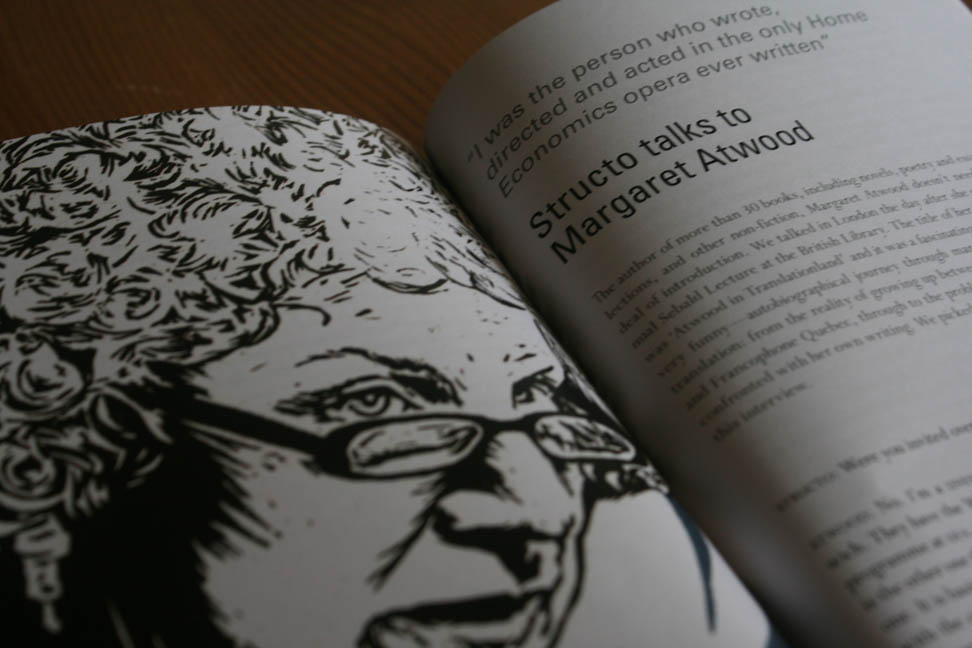
The artwork throughout this issue is by London-based illustrator Jade They. Jade illustrated a piece back in issue ten, and she has written a fascinating blog post about the thought process behind this issue’s images here. The cover artwork is her illustration of John Keats’ ‘Ode on Melancholy’.
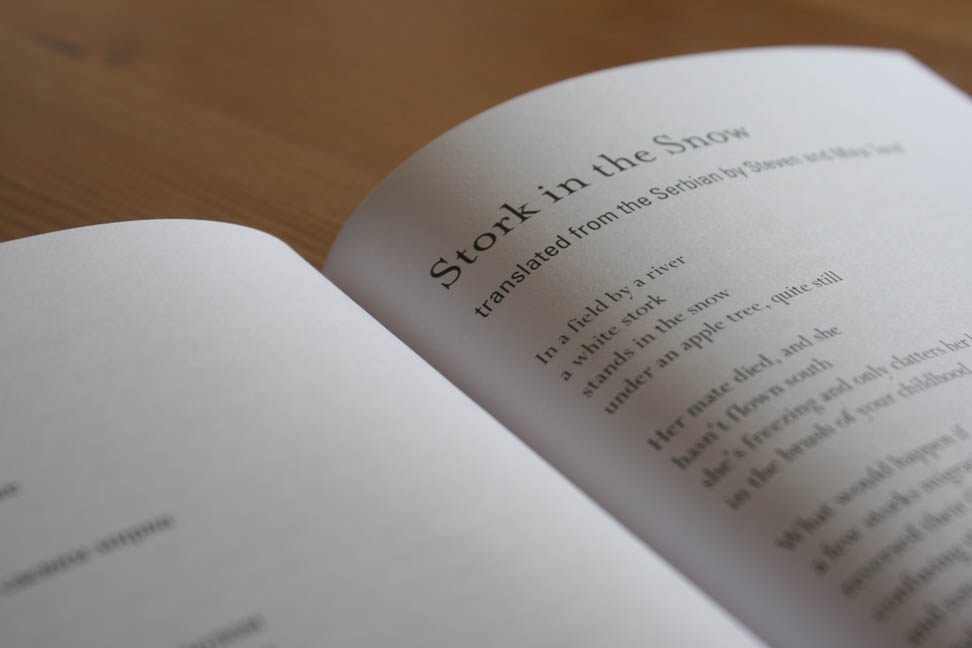
This is another landmark issue. We are working with a new printer and—for the first time—a distributor. This means that, although the cover price has gone up, postage costs have gone way down, especially for overseas readers. So if you like the sound of this issue, and would like to support the magazine, buy a copy in our online shop or from one of our lovely brick-and-mortar stockists.
— Euan
Issue 12 launch
 Where are you going to be on Monday the 18th of August at 7pm? At The Society Club in London for the launch of Structo issue 12, that’s where.
Come along to this brilliant little bookshop/café/members’ club/gallery in Soho for readings and performances from issue 12 contributors Jen Calleja, Eley Williams and Lisa Busby (aka Sleeps in Oysters), as well as for some of the best cocktails around.
You might even decide to pick up a copy of the magazine, which features 10 stories, 14 poems, an essay, an instructional score and a 20-page interview with Margaret Atwood.
It’s free to get in, and you don’t need to RSVP, although a Facebook event page is coming soon if you like that kind of thing!
Review: Brick Mother by S.J. Bradley
 Brick Mother is the debut novel by Leeds-based writer and (full disclosure) Structo contributor S.J. Bradley. It follows the lives of an art therapist, Neriste, and a nursing assistant, Donna, working at a secure psychiatric facility. Both women seem intrigued by the rather sinister yet benign personality of Nathan, an inmate with a sadistic crime in his past. It appears Nathan’s manipulative and remorseless past behaviour resulted in his confinement at the unit rather than a conventional prison, but in comparison to the other patients he appears to be without psychiatric disorder. The plot of the book follows their developing relationships as Neriste and Donna each predict separate outcomes for the deceptive, or misunderstood, Nathan.
I enjoyed Brick Mother for its descriptions of the everyday, its realistic characters and well observed dialogue. It brings to life grimy amusement arcades, greasy cafes and worn-out offices. The miserable repetition of the formality, the cliché of bureaucracy brought to life from this kind of institutional environment. I read it with the distinct feeling the author had some kind of insider knowledge of a similar unit. Moments of tension are well described, but Bradley often dedicates just as much description to the banal; whether looking for a pencil, squeezing past a chair in a cramped room or a bus journey to work, the characters open up their lives to the reader, even in their most mundane moments. Whilst for some this might serve to slow the novel’s pace down, delaying the action, I can believe the frustration of the banal mirrors the atmosphere of the hospital and the stagnation of the main characters’ careers. Either way it is intentional. The blurb describes “… a place where doors are kept locked, where staff carry panic alarms, and where even a pen has to be treated as a weapon.”
Bradley quotes Love’s Executioner by Irwin D. Yalom, and Lionel Shriver’s We Need To Talk About Kevin, as influences. Brick Mother reminded me of writers like Jenn Ashworth and Zoe Lambert for its tone which is urban, northern and authentic.
Brick Mother was published in 2014 by Dead Ink Books. You can find out more, and buy a copy, at their website.
Language Landscape
 If you read Structo you will know that we publish writing from all over the world, as well as translated poetry, usually alongside the original verse. But there can be loss in this translation. Simply hearing someone read the original can bring new understanding and depth. It was shortly after discussing this fact at one of our translation events that we learned about the website Language Landscape. We talked to co-director Ebany Dohle about the project.
What is the aim of the Language Landscape project?
The aim of Language Landscape is to raise awareness of language diversity at both global and local levels. On a global level, we promote language diversity by representing where languages are actually spoken via an interactive web-based map. On a local level we run outreach projects with schools around London, talking to children and teens about languages and language diversity in London and around the world.
How did the project come to be?
All the core members of Language Landscape are linguists who are students and alumni of SOAS, University of London. Linguistics at SOAS has a branch which specializes on Endangered Languages, and every year it celebrates Endangered Language Week. In order to get involved, one year the Linguistics students put together a project to map as many favourite words in as many languages as possible. The idea was to ask students, academics, staff and visitors of SOAS to contribute to the map by asking their favourite words either by writing these on post-it notes and placing it on a large printed map which was on display, or by contributing recordings of their favourite sayings, poems, songs or stories. This was so successful that the group of students decided to apply for funding in order to continue the project.
How many people are on the team?
There are currently six of us on the board of directors. We are the ones who take on the administrative duties of running the website and outreach projects. We also have a team of 10 volunteers who are involved in running the outreach projects, plus all of the contributors who have uploaded recordings to the website.
How did you go about securing funding?
We initially applied for funding from SOAS Alumni and Friends fund to create the beta version of the website. The new version of the Language Landscape website has been developed with the kind support of Google Earth Outreach, the SOAS Alumni Fund, and the UnLtd and HEFCE HEI Initiative/SOAS Student Enterprise Fund which supports student-led social enterprise.
What has been your experience with the site since launch?
Overall the site has been used to create more individual projects especially within schools and universities. As a team we are also engaging with it even more and getting to know all the ins and outs of the new features. It has been really enjoyable to discover and use the new site. The next step is to encourage more members of the public to engage with it as much as we do, and in order to achieve this we are in the process of creating an animated ‘Do it Video’ which will hopefully be ready in a months time.
If that sounds good, you might be interested in a project we just opened on Language Landscape, imaginatively titled the ‘Structo World Literature Project‘. We are looking for you to record your original or public domain literature from all over the world. If you would like to get involved, or find out more information, head to the project page on Language Landscape.
Review: This Room is Waiting by Lauren Pyott and Ryan Van Winkle (eds)
 As part of the Reel Iraq festival in 2013, four British poets travelled to the Kurdish mountain village of Shaqlawa to meet with four Iraqi poets to share and translate with each other. The aim of the project, organised by the non-profit Reel Festivals, was to shed some light on the true nature of Iraq, a country that has endured some pretty brutal Western news coverage in recent decades. Iraq used to be a hotbed of creativity and art, and indeed the roots of this are still thriving despite the war and poverty that has ravaged the country. The project was also meant to form real connections between poets, showing that poetry crosses barriers (language and otherwise) in ways that other art forms cannot. The poems written and translated in this project were presented at the Erbil Literature Festival in Iraq and toured around the UK before finally being compiled into this book, This Room is Waiting.
Poetry in translation isn’t always the most straightforward form as—uniquely—it requires more than one talented poet to make it resonate. The poets on both sides of language barrier in this book are quite obviously talented, and readers of either language will get a unique experience. For some, side-by-side translations can be disconcerting (especially when one language uses a non-roman alphabet), but as a former student of Ancient Greek, I enjoy the beauty of the script alongside the poem that I’m reading. The more you read these poems, the more you appreciate the look and feel that the Arabic versions present, even if you don’t have a clue about what is actually written there. Reading these gives one the feeling of a sort of enlightened confusion: of appreciating the translation while also having a strong desire to understand the original.
Mixing up cultures, experiences and styles can be a recipe for literary disaster—often editors throw together anthologies for the sake of doing so without really thinking about the effect one may have on another. What This Room is Waiting gets completely right is selecting poems that carefully assess the two cultures that the poets represent. The poets’ culture and experience shines through the poems, but there’s also a sense of connection based on the shared experience of writing and translating together.
Even though the poets are from different places and backgrounds, one of the best connections between their shared poetic experiences is how they relate to nature. Jen Hadfield’s ‘Lichen’ is full of rich poetic sound and imagery like this:
Who listens
like lichen listens
assiduous millions of black
and golden ears?
In the same vein, Iraqi poet Zaher Mousa’s excellent ‘The Iraqi Elements’ addresses the relationship between Iraqis and the natural world, specifically water, in these lines:
This is the birth of Water:
Mist is when water dies so that it can be born again.
Sluggish rivers swither among the dead, their banks overflowing.
These two poems are equally adept at characterizing the natural world, but they approach the subject from completely different angles and perspectives. It’s this sort of similarity that really pulls the book and its contributors together.
Of course, it’s the differences between the poets that show why this book is necessary. The editors and contributors want to show the positive aspects of both Iraq and the West, and show that, although the cultures have differences, they can (and should) live in harmony together. It’s fascinating to see different poems riff on similar subjects, often with a very different ‘feel’, based on the poet’s background and culture. Shared history and literary tradition is acknowledged, like in Ghareeb Iskander’s poems ‘Gilgamesh’s Snake’ and ‘On Whitman’. The Western canon often considers The Epic of Gilgamesh to be its first work of literature, but the Middle East literary tradition has just as much if not more claim to its influence. Whitman’s influence on the other hand is almost opposite, in that he is not just chiefly Western, but American. An Iraqi poem responding to Whitman’s ‘Song of Myself’ can’t be common. But that’s what makes this melting pot of a book so great.
I truly appreciate what the editors and organizers of Reel Festivals have done with This Room is Waiting, and it’s a great step in approaching mutual understanding, and peace, through artistic means. The poets, both British and Iraqi, are very good, and their influence on each other drips from the poems in this book. Reel Festivals would do well to continue organizing events which produce works like this. It’s a great thing for both the poetry community and for the countries involved. Poetry might sometimes seem inconsequential, but the poems in this book prove that poetry can connect even the most unlikely souls.
This Room is Waiting was published in April 2014 by Freight Books
Spenser is a freelance writer from Fort Worth, Texas. He graduated from Texas Christian University, and his work has appeared in The Rumpus and TCU’s student literary journal, 1147
Our very own Faber New Poet: Will Burns interview
 We have some very talented writers working at the magazine, and so it’s always wonderful when they get recognised as such.
Earlier this year Will Burns was named as one of four Faber New Poets for 2013–14. Each recipient of the prize, sponsored by Faber & Faber and the Arts Council, will receive mentoring, pamphlet publication and financial support.
We published a number of Will’s poems back in issue six, and he joined our editorial team a year later. He is also a musician and songwriter – those of you who came to our issue eight launch will have heard him perform. Here’s a brief interview with Will about his poetry and the Faber prize.
Did the song-writing come before the poetry?
Well, I suppose the first things I ever wrote were poems. When I was a kid. And then as a teenager, when you get into bands and the idea of making music of your own, it was songs.
When did you start writing poems?
Aside from as a child, it was when I started to study again as a mature student, in my mid-twenties. The band then had a bit of a break when I broke up with a girl and moved away from London for a bit. Funnily enough that was also the end of my studies. But I got really into writing poems then, the songs started to take a back seat. And although we did make another record, I was beginning to realize I was getting more out of writing poems and stories than making music.
When did you first publish get your poetry published?
The first poems published in print were in Structo… and before that on the Caught by the River website, who have been incredibly supportive. I suppose the first one up there was five years ago or something like that.
Those poems we published in issue six were from Sideshow Stories. Can you say a little about the project?
That was a project driven by my wife really. She is friends with Jason Butler, the artist involved, and she had this idea of using these drawings he had done in an exhibition with some poetry or stories. It ended up being very fruitful for me, because it kind of forced me into some reading, research and writing ideas that were imposed rather than coming from my own obsessions. So I ended up writing this whole batch of poems that felt really different in the way they came about and I still feel really good about a few of them.
And Caught by the River?
It’s quite a hard thing to pin down exactly, Caught by the River… it’s a magazine, I suppose, but they have also published books of essays and non-fiction. They have a book coming out this year, and they organize events and curate festivals as well. A curious mix of things, really. But it’s a wonderful thing, whatever it is, and the three guys in charge, Jeff, Andrew and Robin, are just people who get excited about things, whether it be music, writing, art… so the website and books are imbued with that sense of excitement and enthusiasm. It’s a privilege to be involved with them.
And the way that happened kind of relates to your earlier question about how I started writing poetry, I suppose… I had just met Nina, who was to become my wife, and one of the first things we did together was go to Port Eliot Festival, where CbtR curate a stage of readings and music. Nina had already started to be encouraging about my writing (as well as painfully blunt about my musical aspirations, I might add!) and while we were away that weekend I wrote a couple of poems. She told me I should send them to Jeff (at CbtR) and see if he’s up for publishing them on the site. At the time I hadn’t sent any submissions off before, and when Jeff was positive about them, it meant a great deal.
Since then, I’ve become a regular contributor and it really is a great thing to be involved with, I’m incredibly grateful for Jeff’s support. He’s one of the best people on the planet in so many ways. Always interested in what you’re doing, instinctively good taste, obviously great fun if you’re out with him as well.
What was your approach to the Faber application?
Well, I had put together a very small self-published, hand-printed thing a couple of years ago to sell at festivals and readings when I started to get regular bookings, just to help pay for beer, really. So I started with those poems, and since then I had written four poems that I wanted to go in. They were recent poems that I felt good about. So it was a case of choosing the strongest poems I had for that, really. And I did think about the running order as well. The first poem, for example is a poem I always imagined as the first poem of a collection. I almost don’t think of it existing outside that, in a strange way… almost like it doesn’t have a full poetic life of its own outside of the poems that follow it. But basically it was a case of, ‘What are the strongest 15 poems I have?’.
How do you choose poems for a collection generally?
I’m a complete novice at it, I think… there’s only been that first thing, and the Faber pamphlet. I am working towards a first full collection, though, and feel it’s nearly there, so I am always thinking of the poems as a body or work, so I suppose the way 40–50 poems feel together is starting to be the way I think about them, rather than as these tiny little miracles of their own. It’s an interesting process, the sort of thing I really like, actually. I much prefer editing and collating than the hard work of getting the stuff down in its raw form.
What are your plans for the year, poetry-wise?
The Faber New Poets tour is in October and the pamphlet comes out then as well. I suppose that will be the big thing for me this year, but I’ll also be poet-in-residence at Festival No.6, and reading at Field Day for Caught by the River, maybe a couple more festivals as well. Of course I’ll have Structo reading to do as well, and there will be Branchage Festival which I’ll be involved with in some capacity… and trying to write a lot more than last year. Sounds damn busy, actually, now I see it written down.
–
Find out more about Will’s poetry at willburns.co.uk
Posts pre-April 2014 are here.