
Review: The Normal State of Mind by Susmita Bhattacharya
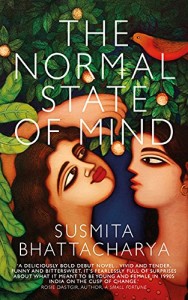 Parthian proudly celebrates their ‘carnival of new voices in independent publishing’, and the jacket from Structo eleven contributor Susmita Bhattacharya’s debut novel promises no less; it dances with verdant greens, bold reds, even a faintly sexual charge between two female figures. Superlative quotes from critics promise beauty, humour, tenderness, love, and friendship, all set against a thrilling backdrop of 1990s Mumbai in political upheaval.
The story, following the changing fortunes of two young women in Mumbai and Calcutta, is no less promising. Dipali is the shy new bride, implausibly happy in her marriage to Sunil, who is bold, smart, funny, and sensitive: the perfect husband. Moushumi knows her own heart, but her conservative family and community forbids her to follow it; she is in love with Jasmine, a rich socialite married to a famous architect, and their affair must remain a secret.
[Moushumi] buried her face in her hands and wept. ‘Mother Superior said to me that I’m not normal. I have gone against God’s ways.’
‘Ignore her,’ Dipali hissed. ‘Who has the right to decide what’s normal? I’m not normal either then. My brother called me a whore. Can anyone define what is normal?’
In the first half of the novel, starting in 1990, Dipali and Moushumi’s lives run in suggestive parallel—the blissfully content domestic life of a ‘normal’ couple set against the clandestine affair of lesbian lovers who have to hide their love from both family and society. A tragic course of events in 1993 bring these two women together in Mumbai and force them to confront the ways society has marginalised them both. Together they find the strength to live life on their own terms.
Bhattacharya writes fondly of the rich detail, linguistic diversity, food, drink, colours, and aromas of her home city of Mumbai:
The street lamps glowed orange and the promenade was busy with people out celebrating. Youngsters and older people alike waved sparklers around, creating light lines in the air. Showers of sparks flared up from tubris, accompanied by laughter and cheers.
Passages like these demonstrate a meticulous recreation of the city, its landmarks, and the mood of a society wrestling with change. There is a lightness, empathy, and humour that sparkles throughout the prose, such as in a humourous scene of elderly women terrified by the installation of new escalators at the train station. It’s easy to see why Parthian has championed this author’s debut; her voice is warm, accessible but unique, offering a refreshing female perspective and experience amidst a crucial moment of political upheaval and social change in India.
Her pared-down style is evocative and suggestive in the short story form, such as in the dark ‘Comfort Food’ in Structo issue eleven, or the epistolary story she contributed to Parthian’s fine Rarebit anthology. But stretched taut over the long course of this novel, the style begins to wear thin. Bhattacharya attempts to capture Dipali’s range of emotions, from her euphoria as a new bride to her grief and eventual recovery; however, the simplistic prose dilutes the emotional impact the reader might experience. In the following scene, Dipali clutches her dead husband’s watch and revisits the sadness, anger, and frustration of the tragic night that changed her life:
She longed to feel Sunil’s touch on her body. His breath in her ear. She covered her face with her hands. The warmth of a loved one in the same bed was what she wanted. That night, she wanted Sunil as she had never wanted him before. But her arms were empty, and the bed was cold.
Scenes progress in this abrupt staccato, making it difficult to empathize. Likewise, characters ‘throw back their heads in laughter’, or their bodies ‘rack with sobs’, and the unreality of their emotional reactions makes it clear that the characters are simply placeholders. Because Dipali and Moushumi’s reactions and emotional states are presented so flatly, nothing feels real or affecting.
These stylistic quibbles are not an insuperable problem; Cynan Jones, another Parthian author, uses blunt, sanded-down prose to incredibly moving effect in The Dig, for example. The problem that undercuts this novel’s ambition and good intentions is the way it unwittingly relies on the same insidious assumptions at the centre of mainstream romantic melodrama: that a woman’s success, happiness, and fulfilment in life directly relate to her success in romantic relationships.
Take the fact that both Dipali and Moushumi are teachers. It is a career that shapes your view of the world and your place in it; you are a role model with a responsibility for the future of others. It can be an all-consuming, frustrating, and immensely tiring job. But apart from being told that Dipali and Moushumi are teachers, we never learn who or what they teach, or how they feel about their roles as educators when they both feel so ‘abnormal’ in their personal lives. What they do seems less important than who they love.
In several instances, the two young women need men to progress the plot. The suave and confident Sunil opens Dipali’s eyes to sexuality and independence, and then the mysterious photographer Gundharv turns up to enable another stage in her life, bringing her out of grief and withdrawal. He also handily takes care of Moushumi’s dilemma by gifting her a job (one completely unrelated to anything we know about her or her character at that point). And this is where the novel falters. The author inserts jibes targeted at the romantic clichés of Bollywood cinema and cheap romantic pulp fiction, but the tropes are used throughout the novel with alarmingly regularity. Dipali and Moushumi are pressed into a situation that forces them to test the assumptions of their patriarchal society, but their route forward is only enabled by men.
— Dan
–
Dan Bradley is a writer, critic, and translator from Japanese. He lives in London.
The Normal State of Mind was published earlier this year by Parthian.
Notes from AWP
 Poetry editor Matthew Landrum (pictured left with issue 12 author Lawrence Schimel) reflects on the recent AWP Conference in Minneapolis.
With twenty official hourly events, many offsite offerings, and an 18-row book fair, AWP is overwhelmingly wonderful and wonderfully overwhelming. I heard Willis Barnstone and Donald Revell hold forth on translation theory, Anne Carson read a lyric hybrid essay/poem on Proust, and the editors of top presses talk about the trials and delights of publishing work in translation. Such are the joys of AWP.
This year held new Structo-related joys. We participated in a table of journals and presses from Germany, England, and The Netherlands. There were juniper gin shots and great conversations with new authors. But the greatest privilege was the chance to talk to the Structo writers who stopped by the table, people I’d corresponded with and published over the last three years and finally had the chance to meet or re-meet in person. I got the chance to have drinks with six of our poets, had dinner with one of our translators, and randomly met another author while working on my ALTA translator’s bingo card.
“AWP fatigue is real!” a friend and previous attendee texted when I wrote that the conference had tired me out. It is. But it’s a good tired. I have a suitcase full of books and a brain teeming with ideas. Structo ran a postcard contest during the fair – any piece that could fit on the back of a 5×8 postcard was eligible to win a subscription and/or be published in issue 14. Now to sit back in the non-AWP quiet of my porch and read submissions from new potential authors. And who knows, maybe I’ll run into them at the next conference!
— ML
State of mind: An interview with Susmita Bhattacharya
 Another post in our ongoing series: an interview with author Susmita Bhattacharya. Read her short story ‘Comfort Food’ online in Structo magazine issue eleven.
Can you say a little about where ‘Comfort Food’ came from?
‘Comfort Food’ came from a personal experience. My husband had just quit the merchant navy and come ashore to work in a ship management company. We moved to Singapore and suddenly we were plunged into a world of business, making deals and buying ships. Rather he was, and I stayed home, waiting long hours for him to return home from work.
Then one day, he was taking a prospective ship buyer to a business dinner in a very posh restaurant. Being a vegetarian, my husband didn’t want to put off this Chinese man by not eating meat, and maybe jeopardizing the deal. (We’d never met a vegetarian Chinese person, so wasn’t sure if he would feel insulted. Or maybe I convinced him that way so that I could offer my presence!) So I happily stepped in to accompany them, and I must say, I had the most amazing deep fried prawns dipped in egg yolk among other such culinary delights that night!
The food bit in the story is real, but the rest is fiction. But I think also the protagonist’s state of mind kind of reflected mine as I was very lonely in that very busy city.
How did you find the process of writing The Normal State of Mind compared to your short fiction?
The novel of course was a completely different process to writing short stories. When I write short fiction, somehow I always think of the ending. And then I work backwards, and shuffle ideas around in my head before putting pen to paper. When I first started writing short stories, it was always in longhand. But the novel was always typed on my laptop. Now everything is on my laptop. I only write shopping lists in longhand, sadly.
The novel was written in several parts, over several years. Short fiction, I write the first draft in one go. And then of course I go back and keep working on it until I am satisfied, or tired, whatever comes first.
What are you working on at the moment?
I have a collection of short stories ready. They’ve been published in several different places in different formats, and I think it will be good to have them all together in a collection.
I’m working on a novel, and also on a few essays. Ever since my cancer diagnosis and treatment, I’ve been reading a lot of non-fiction relating to illness and medicine and found it really cathartic. I’ve been writing about my cancer journey, but want to take it further and explore non-fiction through my personal experience.
The new novel started off from a short story I wrote for ElevenEleven, the literary journal of the California College of Arts. The story is called ‘Where do dreams disappear’, and I follow the life of a young girl who is married off to her best friend’s father. That is the beginning. I don’t know how it will end, as I am still in the thinking process after chapter three.
I am also working on several query letters to agents, as I think it is time I need to get organised and give all the time and effort one needs to put into the writing process without having to worry about the other things.
Read more about Susmita Bhattacharya and her writing at her blog.
Psalm Contest Winner: Adie Smith's A Psalm of Waiting

Photo (CC BY-NC-SA 2.0) by Marco Martinelli.
This from our poetry editor Matthew Landrum.
When I put the first call out for my annual psalm contest, I had no idea the direction it would take, what a wonderful response the prompt would elicit, and how much beauty would be born from the challenge. In the last two years of the contest, we’ve received entries from all over the world, publishing six submissions and nominating two for Pushcart Prizes and one for a Forward Prize.
It’s a testament to the quality of the psalms that we’ve printed more than just the winning entries. One entry this year is from the standpoint of a sharecropper in Mississippi. Another features Walt Whitman. Another has Alcatraz in the backdrop. Out of the thirty entries submitted this year, we’ve chosen three.
Here’s an excerpt from the winning poem, Adie Smith’s ‘A Psalm of Waiting’:
We broke an unblessed communion of body and blood,
bodies breaking against each other.
Our tongue tasting its missing self.
The moon pulled me out on the bed in drops
dark as holes in the white sheet.
Midsummer: An interview with Lawrence Schimel
 As part of our on-going series talking to past Structo writers, I caught up with Lawrence Schimel over email during as he bounced between countries last month. His work is at the intersection of Structo’s commitment to gender equality and interest in poetry in translation. We talked about his press’ work addressing the gender imbalance in translation.
—Matthew
So, first off, it was good to have the chance to meet you in person (by accident) at AWP. With Structo‘s international character, our authors and translators are farflung and I rarely get to meet them face to face.
That’s one of the reasons I try and get to AWP when I can; not so much to meet international-based writers, editors, and readers, but because it is one of the greatest concentrations of English-speaking book-loving people. It’s a high intensity dose of English-language literary scene, which I don’t get much of in person in Madrid, Spain, where I’m based. Madrid is one of the key points of the Spanish-language literary world, and also a major center through which writers from many other languages pass through as well.
AWP has also become increasingly more important for A Midsummer Night’s Press with the decline in independent stores and fewer stores, in general, willing to stock poetry. AWP was 18% of our overall volume in 2012, but 40% in 2013, although back down to 20% last year. We’re not through with the year, so it’s impossible to calculate what percentage of our sales it will prove to be, although sales in Minneapolis were up 20% over Seattle.
At AWP, I attended a few panels by Open Letter. They run a site called The 3% Blog, referring to the fact that only 3% of the literature published in America is in translation. You’re addressing a subset imbalance of that imbalance. Could you tell us what led you to that and why A Midsummer Night’s Press took up this mission?
I wear many hats: my own writing, in both Spanish and English; my work as a translator (primarily from Spanish into English); and my publishing books of poetry with A Midsummer Night’s Press. A Midsummer Night’s Press has always had a good gender balance across its imprints (nine female-identified authors and eight male-identified authors, not including the two imprints devoted only to women writers, Sapphic Classics and now Periscope).
As a translator, I was very aware of the difficulties involved in publishing poetry in translation and wanted to try and use the press to address that, somehow. I’d also seen first-hand how it was often easier to place projects I’ve translated that were by male authors, or that the projects which received governmental or institutional funding were those by established male authors. Looking at the number crunching of the Translation Database compiled by Three Percent for 2012 and 2013 (the two years before I decided to start the Persicope imprint) wherein only 26% of all books published in translation in the US across all genres (fiction, non-fiction, poetry) are by women authors, there wasn’t any doubt in my mind that the translation project I needed to undertake was an imprint devoted to bringing more of those women’s voices to English-language readers.
Do you have a theory on the origins of the imbalance?
Power, plain and simple, and people with power both wanting to keep and perpetuate that power, often by belittling or dismissing any other voices, while declaring their own to be universal and valuable.
This happens in so many ways; you can see how the important work that VIDA does remains necessary, how so many people, when shown the hard facts of the matter, continue to justify and make excuses, not to mention many who continue to perpetuate the imbalance.
Which happens because of who is chosen to be published, even who has the luxury of time to write, or is able to study writing, or even feel herself having something worth writing, something people may want to read. It happens with who is reviewed, and then how they are reviewed. I remember how appalled I was when Jennifer Egan won the National Book Award for A Visit From The Good Squad and the LA Times ran a photo of Jonathan Franzen and made the story about his losing the award; even when a woman won a major prize, the media made it all about the straight white dude. I remember how when my first short story collection was reviewed here in Spain by El País, and the reviewer complained that the stories were, “written with skill and an understanding of the genre, but it was tiresome that all the characters were homosexuals”. Typical of heteronormativity to use such a dismissal of a book even while acknowledging it’s positive or worthwhile aspects.
It’s a shame that Joanna Russ’ 1983 book How To Surpress Woman’s Writing, which analyzes many of the ways that writing by women has systematically been suppressed over history, has been out of print for so long–that very fact is, in many ways, part of the problem of the system.
How do you find your authors and translators? Do you seek them out or do they come to you?
Oh, if only we could find readers as easily as we find authors and translators!
Our first titles were all from writers I had met, often at various international poetry festivals or workshops, although since the series now exists and we’ve been fortunate to get a lot of publicity for it (more publicity than sales, still, but I knew that it would be difficult to promote translated literature without having the authors present to do promotion, in most cases; my hope is that over time the accumulation of titles will have enough weight behind it to compensate) we are getting more queries from translators or poets, and also from the national literature or arts bodies of various countries, proposing titles that might work. Since we have no other funding, aside from sales and what I can put into it from what I earn as a freelance writer and translator (without an academic position or other support to fall back on), any help we can get for the translation and/or other publishing support, makes a huge difference.
Our publishing schedule tends to go in fits and bursts, depending on cash-flow, and also what projects we can afford to do at a given moment, or which might even be able to earn enough to put toward some of our other, riskier projects (such as the Periscope series).
So far our most-popular titles most consistently are those in our Body Language imprint, focused on LGBT voices; this is true whether from debut authors, whose first collection we’re publishing, or established and award-winning authors. Which underscores the ongoing need for more venues for these voices to be brought into the world, that there is a readership out there eager for these books. With Periscope, I am aware of doing things backwards: believing in the work and trusting that we’ll find a readership (eventually).
This is the advantage of being small, and autocratic; I am putting my money where my mouth is, and at the same time I am not responsible to a board of accountants, who demand X profitability within X time frame. If a book takes a few years to finally earn back the investment, that’s OK, even if it may mean we can publish fewer titles in a given year (unless I have an unexpected success of my own as a writer or translator and can kick in a bit more to the press to make up for the slow sales).
What I definitely don’t want to do is to resort to reading fees or contests as a way of subsidizing the press.
So I guess my best advice to any translators or poets wishing to publish with us is to tell everyone they know to buy books from us (we offer free shipping in the US, and internationally as well if people order at least two titles from us via the website) so we can afford to bring out new titles.
What are some project slated for 2015-2016?
Our publishing schedule is rather anarchic, dependent in large part on when we can afford to print more books. One reason I’ve avoided some sort of a subscription is not wanting to be tied into publishing on a set schedule.
So far in 2015, we’ve published a chapbook by Rigoberto González, Our Lady of the Crossword, exploring what it means to be queer in Mexico, the US, and the borderland between those two countries, and this fall we’ll be publishing a new collection by Julie R. Enszer, Lilith’s Demons, exploring that Jewish myth through a feminist lens.
We’re also working toward a large project in our Sapphic Classics series of reprints of important lesbian-feminist texts, in this case The Complete Works of Pat Parker which will be out in spring 2016. It is a much larger book than anything else we’ve published so far, and is requiring more time and energy as a result.
We’ve also got a few translation projects on our desk, but have not yet signed anything so can’t quite spill the beans just yet. The translations also have a longer gestation than many of the other books we publish, but it’s likely we’ll have a few available all at once in fall 2016.
As an editor there are lines that carry a special resonance or get stuck in my head. Maybe you could leave us with a snippet or snippets of a few such poems?
Here are three snippets from A Midsummer Night’s Press titles:
Once we had shared–
razors, toothbrush, a blanket,
like sea and air share the horizon,
reflecting, penetrating each other,
each better suited to any given thing,
—Michael Broder, “Words and Things” from THIS LIFE
When I Was Straight
Everything came to me vicariously–a promise,
a post-script, a preview of coming attractions.
Desire a quiet rumor that rippled through the halls.
—Julie Marie Wade, ‘When I Was Straight’ from When I was Straight
Any day I’ll get some boxes
and empty the storeroom of useless memories.
I’ll leave them in the street, beside the garbage can
in case they’re of any use to someone.
Any day I’ll see them, my memories,
in the hands of another woman
who knows how to appreciate them.
—Care Santos (tr. Lawrence Schimel), ‘The Great Atlas of the Human Body’ from Dissection
–
Read our review of the first three A Midsummer Night’s Press’ Periscope titles here and Schimel’s issue 12 poetry translation here.
Our second chapbook
 We’re pleased to announce that we will be publishing Christina Seymour’s Flowers around Your Soft Throat as our second chapbook, and our first of poetry. This collection explores death, love, and hope, pacing through death’s shadowy valley and beginning an ascent of the opposite rim. Seymour writes of the frailty of the heart; she pities “the earthworm, with its two sexes and five impossible hearts.” But these poems aren’t simply a confessional or autobiographical arc. There are ekphrastic pieces on Song Dynasty silks, Mark Rothko, and Dante Gabriel Rossetti and an imitation of Psalm 45. Seymour’s style is textured and detailed with a subtle musicality as evidenced in ‘Sacred’:
The crinkled gingko leaf shifts like a cricket for a moment before succumbing to stillness. Each imagined boat on the harbor of a well-lit memory is still, just as I sit quietly long enough to maybe feel finished, like him. One pinprick is a seashell, becoming water from a point, and still the shadows grow across some distant prairie, absent each of us.
The chapbook will be available for purchase later this year.
—ML
Photo (CC BY-NC-SA 2.0) by Thibauld Nion.
Issue 14 launch

The issue 14 launch will take place on the 25th of July, at London’s Society Club in Soho from 7–9pm.
As usual it’s free to attend, and there will be plenty of magazines and readings and cocktails to make for an excellent evening, so find some lit-friendly friends and let’s celebrate bringing another batch of incredible writing into the world.
The night will feature short stories from Victoria Briggs, Pia Ghosh Roy and Catherine McNamara and poetry from David Russomano.
Location: The Society Club, 12 Ingestre Place, London W1F 0JF
Facebook event page: facebook.com/events/994003260631321
—Euan
Review: Glass by Alex Christofi

The Window
My dad’s a window cleaner, so I’m looking forward to telling him about a story in which the hero is someone from his own world. In Alex Christofi’s novel Glass we’re offered a window into the life and death of one Gunther Glass, who, following the loss of his mother and his father’s resultant plunge into alcoholism, finds local fame by replacing the aircraft warning light atop the spire of Salisbury cathedral. His stature is further raised when this act brings him to the attention of John Blades, window cleaner to the Queen, who enlists Gunther on some high profile (high in terms of both prestige and dizzying distance from the ground) window cleaning jobs. This necessitates a transfer to London where Gunther moves in with The Steppenwolf, a reclusive author who survives purely on a diet of fish as he continues his 30-odd-year work on a definitive guide to living. Glass finds love with Lieve, a psychic medium with the ability to see a couple of seconds into the future, and learns more about Blades, a character who seems to not only have some UKIP-style ideas about nationalism and immigrants, but also the inclination and the means to engage in the much more hard-core tactics of terrorist groups like The Cagoule. 1
Gunther carries the story by being fun to spend time with. He’s reminiscent of Forest Gump in that he’s relatively innocent of worldly ways, which often leads him to respond to situations with an inoffensive purity that highlights absurdity. When he visits a Ride-Thru-Pop-Up Cycle Café, Gunther is treated to a mini lecture on reducing his carbon footprint by cycling, to which he points out that the café serves their free-poured flat whites in disposable cups. Rather than this coming across as gratuitous hipster-bashing, it becomes part of Gunther’s gradual realisation that there’s no such thing as purity. As Gunther himself says, since the death of his mother he’s been searching for something pure, hence his fascination with both glass and getting as high above reality as possible. It takes him the novel to realise that striving for this kind of purity is impossible, and that people can only do their best when facing the many contradictions blocking adherence to an ideal. It’s not a particularly original thought, but an important reminder.
The Window Frame
Surrounding this straightforward story, however, is a frame. The book begins with a foreword, not by author Alex Christofi, but by a fictional character named Angela Winterbottom, the Dean of Salisbury cathedral. Angela says that Gunther was responsible for her fascination with glass, which is as important to civilization as fire. She has decided to create a fictional account of Gunther’s life because it “amuses” her. She adds the caveat that “if I deviate from reality, or invent a character here and there, I do so only to separate out the various truths”. So what we have is a fictional character fictionalising the life of another fictional character for the purpose of both having fun and telling truths. And if your postmodern siren isn’t flashing like an aircraft warning light by this point, there’s also an introductory quote from David Foster Wallace. Dean Winterbottom appropriates Wallace’s signature use of footnotes throughout the novel.
For the most part, Angela’s interjections into Gunther’s story either quote Bible verses she feels pertinent to the situation, or attempt humourous asides that come off not so much as funny but slightly irritating and seemingly pointless. One footnote, however, puts the reader on firmer epistemological ground by explaining that the way Angela has access to all this information about Gunther is through interviews with the various characters. The reader then knows that a conversation that takes place between Gunther and, say, Lieve, is more or less accurate because Angela must have asked Lieve for the details of that conversation. Where we start to worry, however, is when reading passages in which Gunther is alone with his private thoughts: how could Angela possibly know what Gunther was thinking? It’s not usually a question we ask in fiction because we allow the author this kind of omniscience. But when the author is a fictional character, there’s an inexplicable sense of discomfort at them having the same power. Perhaps that sense of discomfort is the reason that Christofi didn’t dispense with Angela. We’re left not so much looking through a window as through a series of filters that distort Gunther, making his story not simply his, but a mirror for the perceptions of Dean Angela Winterbottom, Alex Christofi, and, presumably, ourselves.
The Mirror
This doesn’t feel like a postmodern novel in the same way that something by Robert Coover or B.S. Johnson does, because narrative is not subverted in the same way. Whereas postmodernism seems to like the mirror as a metaphor because it gives the illusion of reflecting reality whilst actually reversing it, Glass doesn’t appear to want to usher in the full-scale meltdown and retreat into purely self-reflexive fiction that is the logical conclusion of such theorising. There’s a pervading sense of optimism with regards to narrative in the book, which possibly ties in to this idea of abandoning the pursuit of purity and making the best of things. It’s also an incredibly human story, where the reader genuinely cares about the characters. Even if we are uncomfortably reminded that Gunther is a character invented by a character invented by an author, that doesn’t stop him from being endearing. Whilst the alcoholic father might be a pretty common trope, the way Gunther relates to him is handled with an impressive mixture of humour and pathos. During a particularly heated argument, Gunther partially diffuses the situation by pointing out the kidney bean lodged up his father’s nose.
It’s revealing that the only overt presence of author Alex Christofi is in the acknowledgements at the end of the novel, in which the first thanks he gives is to anyone who has ever contributed to Wikipedia. Wikipedia features heavily in the book, first as the resource Gunther uses to learn about glass, and periodically as an impossible but laudable pursuit of making all human knowledge available to everyone. Whilst Gunther’s mother doesn’t see the point of something where anyone can write anything, true or not, Gunther sees it as something “bigger” than any objections that can be raised against it. As Gunther tells The Steppenwolf, what is true at one time is not true at another, and provides (you guessed it) glass as an example. At different times throughout history, glass has been classed as a solid, then a liquid, then a solid again. But rather than panicking that both nothing and everything are true at the same time (this is me extrapolating now, not Gunther/Angela/Christofi) there’s still a point to looking in a mirror, especially, as with Wikipedia, we’re all trying to look into it together.
— Adam
Glass was published in early 2015 by Serpent’s Tail.
Adam Ley-Lange lives and writes in Edinburgh, producing short fiction and reviews for various publications. Along with his partner he runs The Rookery in The Bookery, a website dedicated to the review of translated fiction.
Footnotes:
- The Cagoule or “La Cagoule” as you’ll learn from the novel, was a French fascist group that engaged in false flag tactics in order to advance their far-right agenda. This included attacking their own adherents and blaming it on Communists, thus accentuating the threat of extremist leftist movements and hopefully leading to their suppression by the authorities. ↩
Reader Survey

Photo (CC BY-NC-SA 2.0) by Carnage.
It’s Tuesday. You’ve got nearly the whole week ahead of you, so here’s a quick reminder to help hone Structo magazine by filling out our reader survey! A few short questions. None incriminating. To top it off, you’ll still be entered to win a copy of Alex Christofi’s début novel ‘Glass’!
Thanks in advance. We appreciate what you have to say.
— Christine
Best British Short Stories 2015
 A few months ago we were delighted to learn that Uschi Gatward’s issue 12 story ‘The Clinic’ had been selected for the 2015 edition of Best British Short Stories.
We’re even more delighted to report that the book is now available!
The Best British Short Stories anthology series, edited by Nicholas Royle since its inception in 2011, has quickly become a must-buy for lovers of the short story in the UK, and this latest edition looks set to continue that trend, including as it does stories by both new and established British authors such as Hilary Mantel, Jenn Ashworth, Helen Simpson, Charles Wilkinson, Rebecca Swirsky, Matthew Sperling, Julianne Pachico, Katherine Orr, Bee Lewis, Emma Cleary and Neil Campbell.
We asked Nicholas Royle about the line-up. Here’s what he had to say: “Every year when the Baileys Prize shortlist is announced, I notice it features a preponderance of women. The same is true of this year’s Best British Short Stories – 14 of the 20 writers featured are women. This wasn’t the result of a deliberate strategy. Nevertheless, I was, for some reason, pleased to see it.”
Full details here. Now if you’ll excuse us, we have a book to read.
Posts pre-April 2014 are here.