
Notes from the field: Structo at AWP
 In a 2014 essay for National Geographic, Garrison Keillor described his Minnesota:
“The geography of Minneapolis-St. Paul is simple: Two interlocking cities—the Great River with its rhythmic spelling M-i-ss-i-ss-i-pp-i flowing in from the north, through Anoka and over St. Anthony Falls, past the glass towers of downtown Minneapolis crowded around the Foshay Tower, the brave little skyscraper of my childhood, and the university campus with its long leafy mall and stone columns with the inscription about men being ennobled by understanding.”
It’s no secret that great writers have trolled the streets of Minneapolis seeking inspiration, but perhaps they never will in greater number than right now, during this year’s AWP conference. And our poetry editor is right there in the throng. This from Matthew:
“This morning I entered the fray of writers, thousands of them, at the Minneapolis Convention Center. I’ve had the pleasure of seeing again or meeting for the first time several Structo writers. We share a great cozy booth with some stand-up lit mags from across Europe. I’ll be at the table on and off for the next few days. Looking forward to meeting more past and future Structo authors.”
You can find Matthew at the Versal booth, number 536. Slap his back. Shake his hand. Let him show you the books and magazines. Make sure to grab a postcard and sit in a conference room’s back corner during a mid-day panel, and let something flow. Write us a poem; a story. Maybe you’ll win a subscription, or even appear in our forthcoming issue 14.
Structo is at AWP as part of Amsterdam-based journal Versal‘s #EuroTourAWP. Our thanks to Megan and all at Versal for letting us join in on the fun. Also for letting us nick the photo above off their Twitter feed.
Designing Narrative: An interview with John Björling
Every so often we interview past Structo authors, to see what they’ve been up to since first appearing in our pages. The latest in this series features John Björling, lead narrative designer at the Swedish video game studio Ubisoft Massive, where he is currently working on one of the most highly anticipated games of the year: Tom Clancy’s The Division.
 What led you to your job at Ubisoft Massive?
I joined Massive eight years ago to work on the in-house marketing team for the strategy game World in Conflict, and since then it was a pretty fast journey into actual game development. Before that, I studied literature and worked part time as a game journalist, so I guess you could say that I’ve always been interested in both games and writing and was lucky enough to get an opportunity to work with them professionally. I never really saw myself working with games at all. It wasn’t a profession I ever really considered. I just got the opportunity and seized it!
Your job title is ‘lead narrative designer’. What does that involve?
It’s basically overseeing the relationship between writing and gameplay. A lot of game development is about creating systems, mechanics and rule sets, and that goes for the storytelling as well. The storytelling in games will typically come from a number of different systems, and all of those need to be balanced and maintained to ensure that the end result is enjoyable. As a narrative designer, I’m kind of trying to work on the bridge between storytelling and gameplay, even though there are typically also a lot of other people who are focused entirely on design or writing. So narrative design involves a little bit of everything that results in story experiences in games.
What can you tell us about Tom Clancy’s The Division? I’m guessing not a whole amount! But writing for an MMO must present some interesting challenges.
Tom Clancy’s The Division is an upcoming online RPG that puts the player in the shoes of an elite agent in the middle of a global pandemic. New York has been decimated by a virus and is on the brink of collapse, and as the specially trained agent you’re tasked with going deep into the harshest areas of the city to take back New York by any means necessary.
Working on the narrative for a game of this size and with this complex of a framework is challenging, absolutely, and I’m lucky enough to be surrounded by talented narrative designers, writers, and other developers, who make things come together. The story production is really one big puzzle, full of dependencies and cross-disciplinary work, and it takes a lot of effort to make sure the pieces all come together. It can involve everything from writing thousands of one-off combat barks to having long discussions about why a certain bucket should be blue instead of red. It’s quite different from writing short stories!
How do you view the storytelling possibilities in games compared to more traditional forms? Titles like Bioshock and Spec Ops: The Line have recently done some pretty interesting things with player agency and narrative.
The way I see it, we’ve really only scratched the surface of what games are capable of. Bioshock and Spec Ops: The Line are definitely two examples of part conventional game and part using interactivity in interesting ways, to make the player’s actions have pretty severe implications. I guess they were both even going a bit meta, in a way. But I think that’s the really interesting component – interactivity, and figuring out new ways to make that impact the narrative. Player choices, player perspectives, player involvement. All that stuff. Linear narrative experiences are of course a lot easier and cheaper to produce, but as technology gets more advanced and there are a lot more free tools and engines available, I think we’ll see a pretty rapid increase of the more interactive kinds of narrative experiences.
Aside of that, I think we’re starting to see some really cool things in how multiplayer and social gaming can be used as components in the narrative. But as always, with AAA games being so expensive to make, we’re seeing slow evolutions on the big budget titles, and some pretty crazy smaller revolutions on indie titles.
And lastly, I’m personally pretty stoked about Virtual Reality and what that can mean for the immersion.
Oculus Rift, Sony Morpheus and HTC Vive all seem to be signs that there’s something really cool on the horizon.
As someone who’s very interested in games as storytelling means, it’s a great time to be playing and working on games!
Which other games, past or present, do you rate for their storytelling?
I have a weak spot for Valve’s games, mainly because how they used the silent first-person protagonist in Half-Life and Portal, and how they left a lot of the narrative to the environments around the player. I guess I find that kind of stuff more interesting than well-written cutscenes. It’s a great marriage of gameplay and storytelling without getting hamfisted or losing the pacing too much. Also, Red Dead Redemption’s final hour was something that I’ll remember for quite a while, especially the ‘true’ ending. In more recent years, I think the indie game Gone Home did a lot with very little resources. It really showed how games with a smaller budget can achieve greatness with artistic vision and a feeling for storytelling.
Does your day job influence your other writing?
Yeah, I think so to a certain extent. There are a lot of take-aways from my day job, in how narrative works, what makes for good dialogue, and a bunch of research around New York and all of the typical technothriller elements from the Tom Clancy novels. So New York has become something of a darling setting to me, and all the technothriller research we’ve done has definitely made me more interested in both reading and writing those kinds of stories. But at the end of the day, it’s also nice to take a break from everything and explore completely different genres.
John Björling’s short story, ‘The Cage’, was published in issue six. Find out more at his Tumbr or follow him on Twitter.
This year’s Forward Prize nominations
 We are delighted to announce our nominations for the Forward Prize for Best Single Poem 2015. They are, in alphabetical order:
‘Rooms’ by Mark Mazzoli
‘Dismantling the Cot’ by Philip Miller
‘The Lighthouse Keeper to His Daughter’ by Roisín O’Donnell
‘Safari Hours’ by Annette Volfing
‘Rooms’ and ‘The Lighthouse Keeper to His Daughter’ first appeared in issue 12, which you can read online right now, while ‘Dismantling the Cot’ and ‘Safari Hours’ can currently be seen in our latest issue. Good luck to each of the poets!
On reader feedback and the Three Little Pigs
 Those of you who have followed us over the past weeks and months and years may have noticed that a lot has changed at Structo, both in terms of the physical magazine and our online presence. This iteration is a constant process, and we like it that way.
This great article at A List Apart talks about design criticism via the tale of the Three Little Pigs. It goes a long way to explaining the way we work. We enjoy being the kind of designers the Three Little Pigs were not: collaborative. We keep our ears perked and our snouts to the ground. And we want to hear from you.
We realize that here at Structo it’s not all cream city brick, polished terrazzo, and Sienna shingles. There are likely some sticks and straw and areas that could use improvement, and we’re not at all shy about that. To sort the wheat from the chaff, we’d appreciate your help.
We put together this survey because we’d like to hear from all of our readers. Whether you follow us online regularly or are just passing through, feel free to fill it out. It’s short—one page. And did I mention you can enter to win a copy of Alex Christofi’s début novel Glass?
— Christine
Photo (CC BY-NC-SA 2.0) by Lorraine Phelan.
Families Among Us: An interview with Blake Kimzey
 Continuing our interview series with past Structo contributors, here’s one with Blake Kimzey, whose captivating short story ‘The Skylight’ first appeared in issue nine. The story would later feature in Blake’s collection Families Among Us, published in late 2014 by Black Lawrence Press. The book would go on to win the Black River Chapbook Competition, and rightly so; it’s frickin’ great.
What was the genesis of ‘The Skylight’?
I lived and worked in Paris as a bicycle tour guide on two separate occasions. First, for a year in 2004, and again in the summer of 2008. It was a unique experience to live in France during two election cycles—one featuring Bush as a self-described War President, the next with candidate Obama rightfully promising an end to the American Wars in Iraq and Afghanistan. The second time around, in 2008, my wife and I rented a flat in the 18th arrondissement knowing little of the neighborhood other than its obvious beauty, its cluster of apartments and narrow avenues in the shadow of Sacre Coeur. We lived in the district of Goutte d’Or, a predominantly North African part of Paris, our neighbors mostly Muslim. At call to prayer the Mosque overflowed with believers, their prayer mats checkering the sidewalk and pavement out front. This neighborhood was filled with very warm, generous people who always smiled and said hello despite our language differences. Every day groups of fully covered, completely unknowable women walked up and down the sidewalks together, often with children in tow. Muslim men smoked cigarettes and worked in shops selling luggage, textiles, fabric, and all manner of discounted goods. This was a beautiful cultural experience for us, quite different from our lives back in Texas. I marveled at the people all around us. Their customs and traditions. Their quick smiles. Their dress. Their devotion. And I knew that because of language and many other factors that their culture would never be fully known to me. I was, among other things, a temporary resident in their neighborhood.
But the mystery of the people in the district of Goutte d’Or sparked something that led to ‘The Skylight.’ I was drawn to the unknowable quality of the neighborhood more than anything else. I didn’t have an encounter with one of the local women like the protagonist of ‘The Skylight’ does. As with all fiction, though, I wondered: what if? To me fiction is about the wonderful collisions that characters have with each other, and I was writing a book of short tales and this—a man meeting one of the local women, somewhat clandestinely—seemed like a good premise for a story, reliant on the setting and a few essential collisions. The story refuses an easy resolution, a deliberate choice. Even though I lived in the same neighborhood that is described in the story, I left for America after the summer with only the residue of personal mystery and a feeling of gratitude that we got to live in the 18th if even for a short time. As a writer I’m inspired by place almost more than anything else, and in hindsight, writing a story like ‘The Skylight’ seems inevitable.
Can you say a little about the process of putting together your collection Families Among Us?
The stories in Families Among Us are a departure from the fiction I normally write—comedic short stories (and the darkly comedic novel I just finished), and now, dramatic stories about the Iraq War. But I am drawn to tales and always have been. I love writing them, and the order they appear in the book came together quite naturally, though they aren’t arranged in the order that I wrote them. The first story, ‘Families Among Us,’ felt like the thematic lead and I wanted it to come first as it echoes the title of the book. The rest sort of fell into place by gut feeling. Even though there are only six rather short stories in the collection, this book took me three years to write. Any time I wanted a break from the longer stories I was writing, and then the novel I started (and just finished), I would write one of these little stories. They are challenging for me to write, but also a real pleasure. Writing one feels like a break from the routine, and I love imagining some familiar place infused with mystery and magic. These stories are heavily influenced by Kafka, Borges, Gabriel Garcia Marquez (‘A Very Old Man with Enormous Wings’!), Aimee Bender, Roald Dahl, and Angela Carter, and I love feeling like I’m communing with my favorite authors when I sit down to write. The final story, ‘And Finally the Tragedy,’ felt like an organic bookend to the collection and seemed to tie all six of the stories together.
What are you working on at the moment?
At present I’m revising my first novel, a dark comedy called Don’t Ask that follows two drug-running brothers that get in over their heads. It is set in the frozen American Midwest (Iowa City to Minneapolis), heavily influenced by The Cohen Brothers (Fargo!), Barry Hannah, Patrick deWitt, Denis Johnson, and George V. Higgins. This novel is quite a departure from the stories in Families Among Us, but my great interest in setting as character is present in this writing as well. I wrote the novel last year, my final year of graduate school at UC-Irvine after writing nothing but short stories for the longest time. If I had to describe the novel, I’d say it is the movie Fargo meets deWitt’s great novel The Sisters Brothers. I also have a full-length story collection called Talking Past the Close that is finished, and the stories here are greatly influenced by George Saunders and Thomas Berger and also Barry Hannah. Once the novel is ready to go I hope to secure an agent and see these two new books into the world.
Find out more about Blake’s writing here, and order a copy of Families Among Us here. We’d highly recommend doing both.
Hidden intention: an interview with the photographer Richard PJ Lambert
All images (CC BY 2.0): Richard PJ Lambert
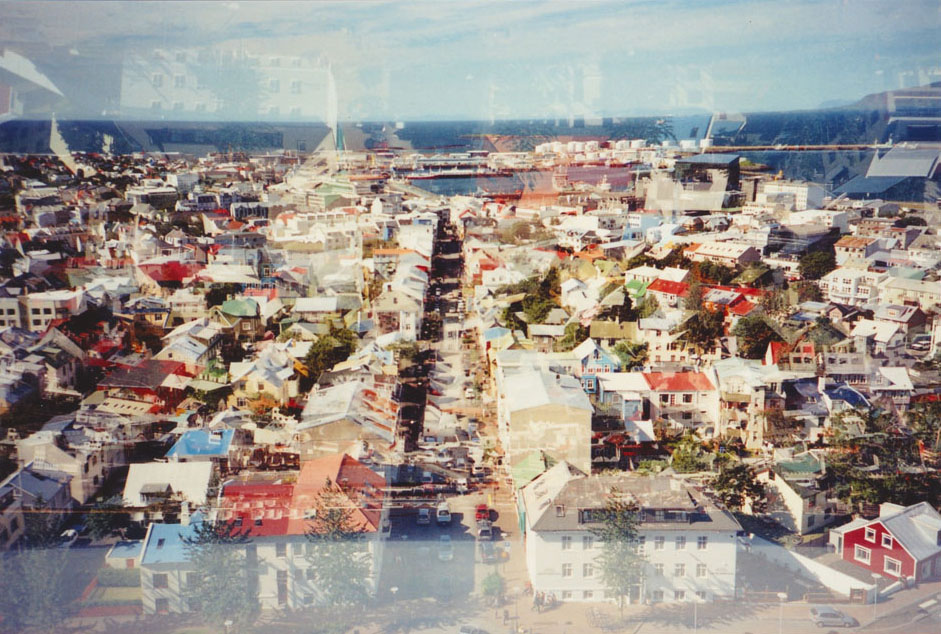
What follows is an interview with the British photographer Richard PJ Lambert. Richard took the stunning image above, and was generous enough to share it under a Creative Commons licence, meaning we could easily use it as our wrap-around issue 13 cover. If you know where to look, you can see the cafe in which our interview with Sjón took place.
Can you tell us about the image we used as our cover?
This shot is a double exposure of Reykjavík taken from the bell tower of Hallgrímskirkja, a huge white church in the city centre. It was on the first day of our road trip around Iceland in the summer of 2014. It was bright and clear and all the coloured buildings shone up at me down to the harbour and towards the mountains. Watch out for the bells though. They are extremely loud and incredibly loud. I almost dropped my camera straight out of the window.
What drew you to Iceland?
Action, adventure and humpback whales all played a part but if I’m being honest, it was mostly Björk. I’ve always been fascinated by her idiosyncratic work and personality. When Björk talks about herself, it is in a way that is inseparable from her homeland. She calls upon the pulse of the ocean surrounding and shaping the island, the vast energy of the glaciers that carve through the landscape and the primal volcanic forces that can bring an entire continent to a standstill. The whole place just sounded like magic to me.
Also, a wedding proposal.

What is your process for shooting double exposures? They’re incredibly distinctive.
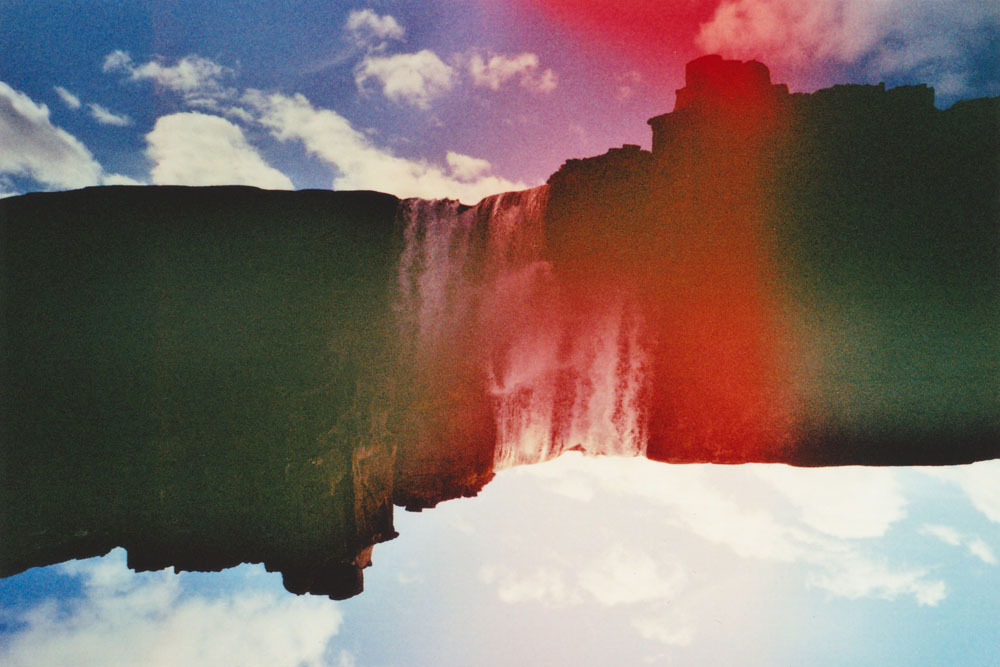
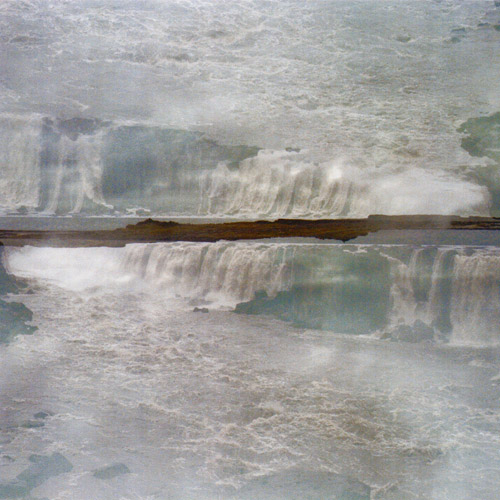
Thank you! I use fairly basic film cameras to expose each frame multiple times. Exactly how… depends. Sometimes I run the roll through twice in different places, other times I mask part of the lens and turn the camera around and shoot from different perspectives. I’m getting closer to a standard operating procedure but I’m happy to let the photographs be their own thing. In one picture, the elements of the composition can harmonise and blend like a dream, the next everything smashes together with jarring dissonance.
It helps to meditate on the Brian Eno quote “Honour thy error as a hidden intention” because I make a lot of mistakes and like to pretend I have emotional depth.
A literary analogue would be William Burroughs’ cut-up method, where he re-arranged existing text to create new narratives. Photography is inherently limited – whatever exists outside the frame or split second of the shutter click is removed. The image becomes divorced from context. Double exposures allow you to play collage with the context to suggest new ways of reading the image. Burroughs thought cut-ups could be a way of divination saying, “When you cut into the present the future leaks out”. It’s nice to think that pictures can have a life of their own in other peoples’ minds, finding new connections, free from whatever intentions I had.
 What are you currently working on?
I’m hoping to be more involved with a photography collective in Birmingham called Some Cities. They organise community projects, set up exhibitions and have an excellent darkroom. They have a wet plate collodion camera which I am dying to learn how to use.
One of my favourite bands, Opium Lord, are putting out their debut LP this year. It features my work throughout which is exciting. Album artwork is what got me into photography in the first place, so seeing my pictures in a record shop is awesome.
I’m very conscious that most of my images are online and I’d like to get them out into the real world. Printing and collecting my work would be the first step but it would appear I have a pathological aversion to projects – or at least defining and organising them. I tend to just shoot everything in the hope that an element of coherence or narrative thread might spontaneously appear. If I really put my mind to it, I would really love to put out a few zines collecting some travel pictures – at least they can be sequenced geographically.
For more of Richard’s stunning photographs, follow these links:
Website: richardpjlambert.com
Blog: rpjl.co
Flickr: flickr.com/photos/auspices
Now reading for issue 14
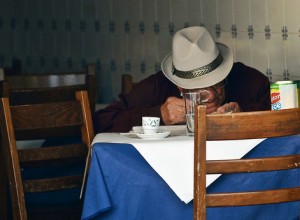 Just what the title says: we are now reading for issue 14. It seems some of you had your finger on the button, as we already have a number of submissions in, just a few minutes after opening the call. Perhaps you got the advance word on our mailing list, perhaps you have spidey sense, but either way, bonus points to you.
For everyone else, the deadline is April 19th. I would advise not waiting until the last minute, as we always get a huge spike of submissions in the last few days.
— Euan
Photo (CC BY): Pedro Ribeiro Simões
Structo seeks reviewers
 UPDATE on March 23: A huge thank you to everyone who expressed interest! We are no longer accepting applications. We will be getting back to all candidates this week. Thanks again!
Not of our latest web updates or our new spring haircuts. Of books. Pristine reviewers’ copies that could use a side of coffee—or tea or boysenberry juice—and a critical pair of eyes.
Email your interest to me, christine@structomagazine.co.uk. I’m new around here, so introduce yourself. Provide samples of previous reviews and a sense of what you enjoy reading. We’re seeking professional nonbiased reviews, but that doesn’t mean they have to be stale. Feel free to send video reviews, audio clips, and other forms conducive to use on the web. Peruse our blog for an idea of the types of books we’ve reviewed in the past.
This project-based position doesn’t currently come with monetary compensation, but your reviews will be published on our ever-blossoming website. Also, you get to keep the books. Who doesn’t like free books?
—Christine
Photo (CC BY-NC-SA 2.0) by Julian Ortiz.
Issue 13 competition
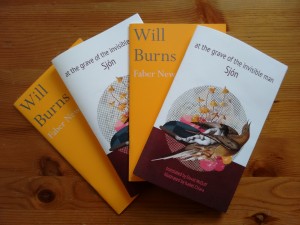 To celebrate the release of the new issue, we have two pairs of poetry pamphlets to give away: one by issue 13 interviewee Sjón and another by Structo alum Will Burns. The copies of Sjón’s At the Grave of the Invisible Man are part of a limited edition of 100 and contain signed slips from Sjón. Will’s Faber New Poets 10 were both signed at the launch.
More importantly, they’re both really excellent, and At the Grave of the Invisible Man looks like it might already be sold out.
One pair of pamphlets will go to a random subscriber at the closing date, and the second pair will go to someone who can answer this question: How did Sjón first encounter the Surrealists? Hint: the answer’s in the issue!
Let us know the answer by emailing competitions@structomagazine.co.uk. The closing date is Friday the 20th at midnight GMT. Again, the winner will be chosen at random.
If you would like to win more signed books, you should definitely sign up to our mailing list, as another giveaway will be announced there early next week.
Writing Chinese
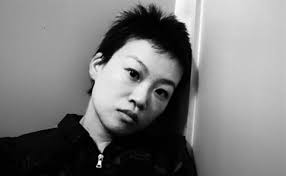 We’re delighted to be a part of the University of Leeds’ Writing Chinese project, based at the University’s White Rose East Asia Centre.
Here’s Sarah Dodd, a researcher at the Centre, talking about the genesis of the project:
The Writing Chinese project came about because, firstly, there’s a lot of exciting things going on in contemporary writing in Chinese and we wanted a way to share this with a wider audience. And secondly, there’s often a tendency for academia to be quite disconnected from any kind of dialogue with writers themselves (especially new writers), or with others working in the field, such as translators, publishers, agents or reviewers. So we wanted a way to bring all these different voices together.The project is funded by the Arts and Humanities Research Council, through the White Rose East Asia Centre (WREAC), and we’ve been able to organize a series of talks by writers, translators and publishers, as well as a translation masterclass, and a planned symposium this summer. And each month we choose a writer – often one who is only just beginning to be translated into English – to be part of our bookclub, with stories in both the original Chinese and in English translation featured on our website.
And this is where we come in. Part of the project is the Bai Meigui Translation Competition. This is, as the name suggests, a competition to translate a story by the award-winning Hong Kong author Bai Meigui. The winner will receive a full bursary to attend the July 2015 translation summer school Translate in the City in London and the winning story will be published in issue 14 of Structo.
The deadline for entries is the 28th of February. Full details here.
Posts pre-April 2014 are here.