
Psalm translation competition
 For the last few years Structo‘s poetry editor Matthew Landrum has run a contest which asks for free translations of biblical psalms during the season of Lent.
Last year we helped to run the competition, and in the process received some top-notch submissions from authors across the world. Some were religious; some were secular. Some kept close to the source material; others made bold departures from the original. The results were striking. We ended up publishing the winner and two others in issue 12. Two of these went on for Pushcart Prize nominations.
Now with Lent upon us again, we’re opening submissions for a second year of the contest. The winner gets publication in issue 14 of Structo, US$150, and a two-year subscription.
Guidelines: choose a biblical psalm and reinvent it in English. We’re looking for work that combines the soul of the original with your personality, poetic, and personal vision. Writers in the past have taken all kinds of different approaches to do this, so feel free to experiment. And to be clear: you needn’t know any original languages or have any (or any particular) religious affiliation, just a willingness to tussle with this lovely, enduring, ancient poetry. Entries will be judged by panel on originality, musicality, accuracy (to the psalm’s spirit), and aesthetic.
Submissions are open until Easter Sunday (April 5th, midnight GMT). You can send us your poems using Submittable, here. To give you an idea of approaches some other authors have taken, you can read psalms from last years contest published in issue 12 of Structo by Shawna Rodenberg, Roisín O’Donnell, and Christina Seymour.
Online editor wanted

We are seeking an online editor. We are now closed to applications—thanks all!
Last year’s redesign brought with it the potential to take structomagazine.co.uk in exciting directions. We want to showcase our contributors’ continued success, share content that excites us, and build a platform that keeps readers coming back. Trouble is, we’re all too busy with the print magazine to do the thing justice.
This is where you come in.
Do you have ideas about how can we make the site better for our readers? About the best way to share the success of our contributors? Is there a vaguely literary blog series that you have been dying to write or commission?
If so, drop us an email by the middle of February. Let us know a little about yourself, and your ideas. If Structo is new to you, take a look around the site and at our back issues, to get a feel for the kind of team you’d be joining. The editorial in each issue might be a good place to start. Feel free to ask questions.
This is an advert for an online editor, not a webmaster; you would be responsible for content, not coding. That said, the site is built on WordPress, so previous experience using the system would be an advantage. You don’t have to be based anywhere specific, but if you’re in or near the UK, then you can join a bunch of us for launches/meetings/drinks every now and again. This position—as with all staff positions at Structo—is currently non-paying. When the day comes that we are able to give our contributors fair recompense for their work, we hope this will change.
Photo (CC BY-NC-SA 2.0) by Richard Alexander Caraballo
Issue 13 launch in Oxford
 We will be celebrating the launch of Structo issue 13 at The Albion Beatnik in Oxford on February 21st, from 6:30pm.
We love the Albion Beatnik, and we have launched our spring/summer issues there since issue nine. It’s a cosy place to be in winter.
If you’ve been to one of our launches there before, you know what to expect: a pile of brand-spanking-new magazines, some short readings by some ace writers, and lots of wine, tea and cakes. As always we are not responsible for all the books you buy when you come along.
The evening will feature several readings from the issue, including poetry from Annette Volfing and Will Burns, narrative non-fiction Gary Budden, and fiction from Alex Christofi.
It’s free to attend, and all are welcome. Hope you can join us!
Facebook event page here: https://www.facebook.com/events/1523687164571480/
A poem a day for thirty days
 Our poetry editor Matthew Landrum is having a busy month. He’s taking part in Tupelo Press’ 30/30 poetry contest, in which six poets write and publish a poem a day, for 30 days straight. I asked Matthew how it was going.
As well as being a challenge for the poets taking part, the 30/30 project is also a fundraiser for the non-profit Tupelo Press. They are an “independent, literary press devoted to discovering and publishing works of poetry and literary fiction by emerging and established writers”. Find our more at their site.
— Euan
Photo (CC BY-NC-ND 2.0) by C.C. Chapman
Once upon a time: Rosebud Ben-Oni
 The latest catch-up chat with a past Structo author is with Rosebud Ben-Oni, a writer and poet based in New York. Ben-Oni’s short story ‘Never My Story, My Name is Yours’ first appeared in issue seven, and can be read here.
What is your writing background?
Well, I attended New York University for my BA in Literature, and the University of Michigan for my MFA, but outside workshops, a hodgepodge of influences. Shel Silverstein and the Torah. Americo Paredes, corridos, South Padre Island, the U.S.-Mexican border. Yaakov Shabtai’s Past Continuous. Edmond Jabes’s The Book of Questions. The particular chill of a synagogue on Yom Kippur morning, the lamplights low, trying to fast alongside my father. I don’t remember writing my first poem; I only remember I was always writing. I wrote because I was filled with endless why. I wrote because I was small for my age, and wanted to make I would have a place in the world later. My childhood worlds were very physical spaces that often resembled the stories I read in Hebrew school. After I read the story of Abel & Cain, I felt a great sympathy for Cain, which horrified some of the class and our teacher. I felt when called upon to offer a sacrifice, he was actually speaking a greater faith in his rebelliousness that Abel, who simply did what he was told. I only remember I was always writing because of rebelliousness, because I wanted to reinterpret the stories of the Torah, because we had to change synagogues because some of the congregation didn’t like that my mother was Mexican and had converted from Catholicism to marry my observant Jewish father, because I wanted the world to understand what my own father had sacrificed in order to honour my mother and his children. My writing background began in the worlds my parents had to create to raise their children who were never completely of the worlds around them, even those of their blood. My writing background is alkali-ed seasons surging along the Gulf coast, wandering wreckage tossed over from the cities I’ve lived, the winding roads of Jerusalem, some distant future always in the setting sun, no filter, no filter.
What was the genesis of ‘Never My Story, My Name is Yours’?
I had dated a Bukharan Jew; she was religious, and could not come out to her family,so while the romantic relationship didn’t progress, we became friends. I would have Shabbat dinner with her family about twice a month, and I’d watch the volatile dynamic between her grandfather and her father, who had never seen eye-to-eye. The story is completely fiction, but it grew from this experience.
What are you working on at the moment?
I’m finishing up my next poetry collection which is called BLOODSPORT, as well as my first novel and my first full length play. I’m also working on a collaboration with the artist Michael Haffkha on the idea of anthropophagi. All of these projects vibe together, so I don’t have an issue with having to hit a mental ‘reset’ to transition from one to another.
Can you say a little about VIDA [the US organisation dedicated to issues of women and writing]? We first heard about their work from you.
I did read your piece here, which was excellent. I’ve worked more with editorial content, but as you saw in your own count in Structo, numbers can’t lie. I believe by pushing more for women writers and writers of colour we can reshape what is US literature and what is the canon, and that of course informs culture. One point I always make to make my students in workshop is that the US is a very young country, and our canon is still evolving. Groups like VIDA, as well as Cave Canem, CantoMundo and Kundiman, are so vital to giving us a more fulfilling and realistic portrait of literary voices and cultural experience in the US.
Online issues and chapbooks
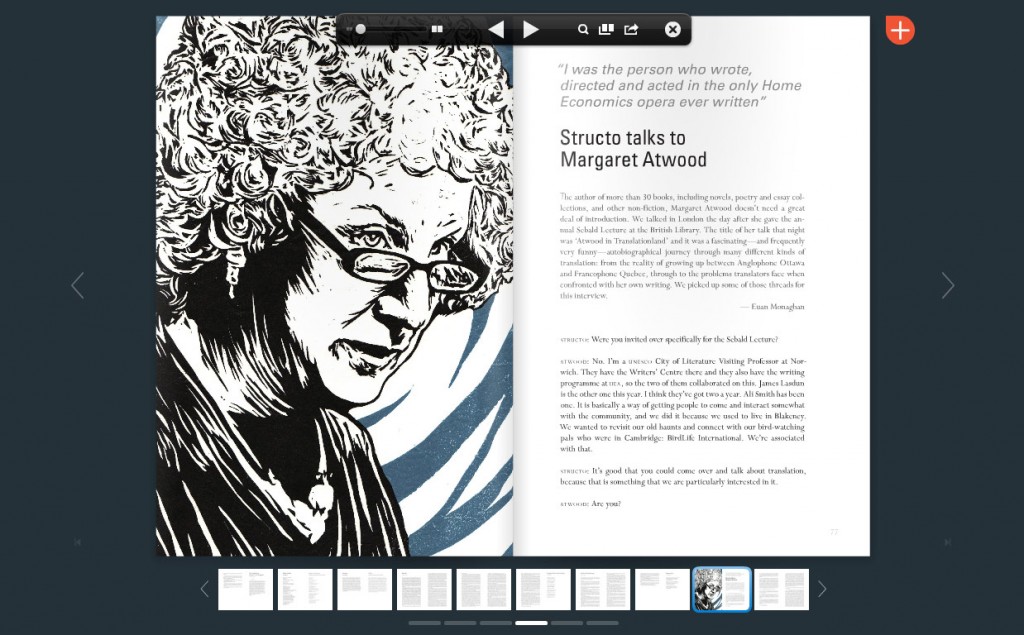
Today, December 21st, is the shortest day of the year. It is also National Short Story Day, at least in the UK. I would love to say that is the reason that I am posting this blog right now, but honestly it’s a complete coincidence.
The first bit of news is that our current issue, number 12, is now online to read, for free, over at issuu.
If you really like the issue you can still pick up a hard copy. We will probably have stocks through January or so. If you’re not an ink and dead trees kind of reader, you can alternatively pick up a (DRM-free) digital copy of our most recent issues over at at 0s&1s. 0s&1s are doing some very exciting things, and we’re delighted to be working with them.
The second thing is to announce our very first chapbook, Fitting/Her Feelings About Auckland by Vicki Jarrett.
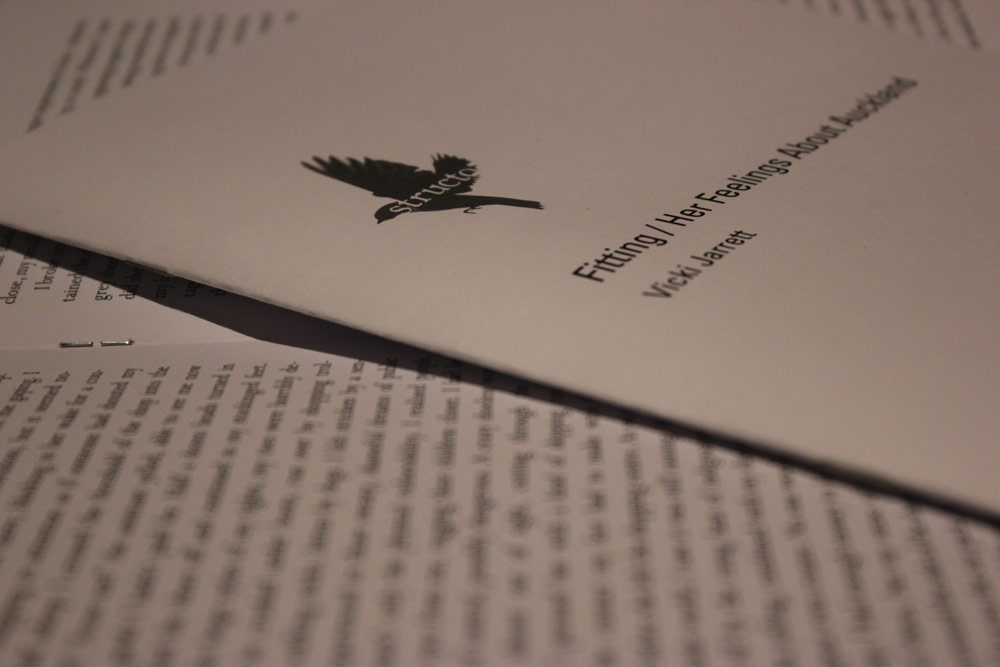
The idea behind these chapbooks is to take full advantage of the incredibly talented authors we’ve published over the years by producing inexpensive, short collections of their work. This one contains two brand new short stories, is 12 pages long and costs £1.50 (plus the P&P to wherever you happen to be). You can pick up a copy at our online shop. A digital edition will emerge shortly.
One of these chapbooks will appear between each of our issues, and the plan is to alternate between fiction and poetry. The author receives all profits from their sale; we just cover our printing costs. Obviously this isn’t going to make anyone rich, but it might buy some talented writers a notebook or two.
That’s it for now. Happy Christmas all.
— Euan
Once upon a time: A.H. Sargeant
 Every now and again we interview an erstwhile Structo author here on the blog. This time it’s the turn of British author and poet A.H. Sargeant, our most frequent contributor, whose stories and poetry featured in three consecutive issues: four, five and six. He’s been troubling our shortlists ever since.
How did you hear about the magazine?
Probably by accident! In recent years I decided to ‘get serious’ about my writing and was surfing the net looking for a publisher. In October 2010 I sold my first story ‘Don’t Beam Me Up, Scotty’ (under the title ‘Lost in Transit’ at the request of the editor) for the princely sum of $10. Dark Adventure was (and is still, I suppose), a US online magazine publishing a ‘Fall Fiction Frenzy’ feature and this decided me to keep looking for a similar publication in the UK. Then I discovered Structo and was delighted when you accepted my story ‘The School of Oriental Dancing’ for your fourth issue in the Spring of 2010 [you can read it here – ed.].
Can you say a little about your writing background?
I seem to have been writing for ever! At my Secondary Modern School (I failed my 11-plus twice!) in London’s East End in the 40s and 50s, English was my favourite subject. Essay Writing – called Composition in those days – was a medium I fell into with enthusiasm. I actually won a London Schools’ Essay competition sponsored by the then Greater London Council and UNICEF. The prize was a Conway Stewart fountain pen and pencil set, presented to me by the Mayor of Leyton. I realized there might be some profit in this writing game!
On leaving the RAF (National Service) in 1956 I eventually got a job as a copywriter in the advertising dept of first, a brewery (!) and then a furniture manufacturer. After several years however, I left and entered marketing proper, where I remained until I retired at the age of 63, whereupon I returned to my first love, copywriting, on a freelance basis. But unlike Fay Weldon and Dorothy L Sayers, still my work never leapt off the page into mainstream literature!
When I eventually called it a day in 2006 or thereabouts, at the age of 72, I knuckled down to creative writing for real. I have in fact, been writing on and off since I was in my twenties.
We have published both fiction and poetry from you. Do you have a favourite form?
As much as I love poetry (stuff that rhymes, preferably) it is, for me to write it, an ‘inspirational’ thing – something really strong must present itself. So the answer is short stories. I love everything about the genre. It may have something to do with the maxim regarding copywriting (and poetry for that matter): ‘the best words in the best order, and the fewest’, but most of all it is the format that allows the reader to discover an event, to experience it for a while, and then leave it, either resolved or unresolved. It doesn’t matter either way. If it is resolved with a dramatic twist at the end, well and good. But if not, if it leaves the reader still pondering the outcome, well, that’s a resolution of a kind – the reader still has to think about it and work out a resolution of their own!
My heroes of the genre are too many to enumerate but among them are O. Henry, Guy de Maupassant, H.G. Wells, M.R. James and of course, Arthur Conan Doyle. You can tell where I am coming from!
And I am compelled to write short stories since I may not have time enough left to complete anything longer!
Structo has opened up a whole new experience and opportunity for my writing (and reading) and without being a sycophant I consider myself very privileged to be numbered among your contributors, indeed, a ‘most regular contributor’. My English teacher (Mr Foote, Snr. – no first names in those days) would be so pleased!
2014 Pushcart Prize nominations
 Another year, another incredible batch of writing. We have nominated stories, poems and essays for the Pushcart Prize for the last couple of years, and the process never gets any easier. It’s a (mostly) democratic process, but all that means is that we agonise over our own choices and then agonise over again once we have a short list.
Without any more ado, here’s this year’s list, in alphabetical order. Those stories and poems from issue 11 are linked so you can read them, for free, over at Issuu.
‘Our Return to Sierra Vista’ by Jeffrey C. Alfier
‘Comfort Food’ by Susmita Bhattacharya
‘With Us The Wonders’ by Tara Isabella Burton
‘The Lighthouse Keeper to his Daughter’ by Roisín O’Donnell
‘The Taste of Regular’ by Toni Halleen
‘Don’t Ask Me To Sing’ by Shawna Rodenberg
Good luck to them all!
— Euan
Review: Songs of a Clerk by Gary Beck

Day jobs are often one of the biggest sources that writers draw from, especially early in their career. This influence is seen in some of the most popular poetry of the 20th century, from T.S. Eliot (banker) to William Carlos Williams (doctor). Sometimes the influence is less subject-based, and more about the structure that a day job provides (or forces), like with Frank O’Hara, whose famous collection Lunch Poems was written during his lunch breaks. Gary Beck’s Songs of a Clerk falls into both categories, wherein the day job (whether or not the author had the job at the time) is the subject of many of the poems, while many feel as if they were written initially on scraps of paper in the midst of a workday.
The O’Hara comparison is clear in regard to the succinct, haste nature of many of the poems, but Beck’s subjects often run parallel to those found in Lunch Poems as well. Take ‘Hold Out’ for example:
Many of the poems in this collection run along this same theme, observing the city around the speaker while grumbling about his separation from it. One could even look at much of this collection as a metaphor for the life of an office worker, in that the poems start to run together like days in an office. While it is a topic that holds of wealth of anger and resentment, the repetition gets a little stale at times. Beck seems to want to hammer these feelings home to the reader, which he definitely does, but after a number of poems that are so strikingly similar it begins to get a little wearisome.
Where Beck does soar, however, are in the longer poems that focus on specific imagery or scenes, while relegating the complaints and repetition to but a few lines. The poem ‘Homeward Bound’ in particular holds a few light and descriptive moments like this:
Lines which finally take the reader out of the office and into a world that isn’t repetitive and drab. Unfortunately, like the life of a clerk, the collection bounces right back into the mundane and muted with poems about the office.
The story being told in the collection is another aspect that is very promising in Songs of a Clerk, but again, the nature of its repetition takes away from any narrative that’s being formed. We see the seasons change for the speaker, even if the gray nature of his outlook takes away from any real images. None of this is to say that Beck doesn’t know what he’s doing with these poems. He surely means to hammer the reader with repetition and drudgery to simulate the life of a clerk. There is plenty of tongue-in-cheek notes within the poems that show the reader that the author does, indeed, know that he’s boring your socks off. With a poem called ‘Repetition,’ he almost describes how the reader must feel:
As the collection winds down with more poems on drudgery and tediousness, Beck comes to an end with his story. In the final poems, we see the speaker headed to the unemployment office and later to the park, where he sits and enjoys nature and the people he observes. This is one of the nicer, more tender moments in the collection, as the speaker has been apparently freed of his job and therefore he can finally be happy. The image is nice, and a breath of fresh air after the endless drudgery of the office life. While I see the story running through the collection, and understand the purpose of the extreme repetition intended to make a point, it was hard to get into the poems when I felt like I was living the boring life of a clerk. So even though I didn’t enjoy the book, I may have felt exactly as the author had hoped.
— Spenser
Songs of a Clerk is available on Amazon.
Spenser Davis is a freelance writer based in Seattle, USA. His work has been published in The Rumpus, The Freelancer, The Billfold, and World Soccer Talk. He can be found on Twitter or at his website.
Margaret Atwood competition
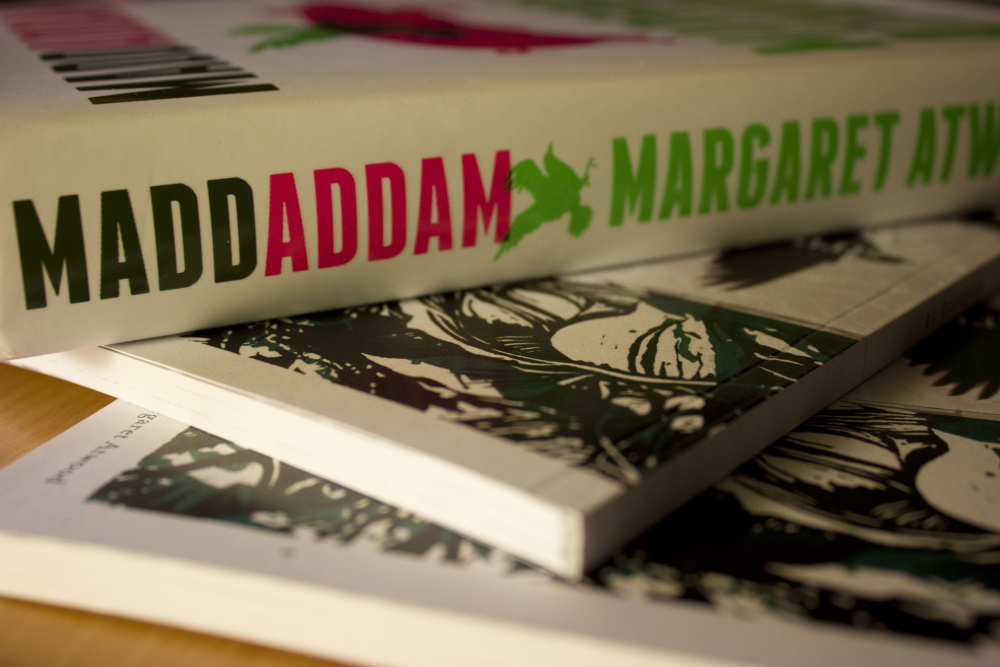
Would you like to win a signed copy of Margaret Atwood’s latest novel Maddaddam?
To enter this draw, just tell us the name that Atwood gave to the wandering knight in the Home Economics opera she penned as a teenager. Hint: the answer is about six pages into our 20-page interview in the latest issue.
Identified the knight? Email competitions@structomagazine.co.uk with ‘Atwood competition’ in the subject line and your name and address in the body text by midnight GMT on September 30th. We’ll choose somebody at random from the entries on October 1st and let you know if you’ve won soon after. We won’t use your email address for anything else (unless you’d like to be added to our mailing list, in which case let us know in the email).
Posts pre-April 2014 are here.