
Popshot recommends
 In this, the final week of our current submission window, we are asking the editors of some of our favourite literary magazines to recommend some of their favourites in turn. First up: Popshot‘s Jacob Denno.
“The White Review is a quarterly magazine that’s published in print and online — featuring poetry, fiction, interviews, art and reportage. The design is timeless and everything about the magazine oozes class, from its content, to its bespoke typeface, all the way through to its editors: Jacques Testard and Benjamin Eastham. With support from its readers and potential readers, the magazine could comfortably go on to become as reputable as The Paris Review or Granta.
“Funhouse isn’t a magazine that I’ve read (largely because it isn’t actually out yet) but it launches this autumn and looks like a beauty. Neatly designed with a strong visual arts slant, Funhouse dubs itself ‘a magazine of writing, comics and illustrations’. Since Popshot launched back in 2009, there have been quite a few titles that have combined new writing with illustration — some of which are still going, some of which aren’t — but I hope this one gets off to a flying start.
“Bare Fiction shares a few of the same contributors as Popshot, so it has a taste level that isn’t too dissimilar. Despite being relatively fresh to the literary magazine scene — having launched in December 2013 thanks to a successful Kickstarter campaign — it’s managed to build up a pretty strong following in a fairly short space of time. They’ve also recently launched a debut poetry collection from one of our most published writers, Zelda Chappel, which will be undoubtedly brilliant.”
If you’re interested in Popshot (and you should be), this is good timing, as they have recently re-published their latest edition in supplement format. It’s around half the usual issue price, but limited to 200 issues, so pick one up before they’re all gone!
Fall Ball: an interview with John Glass
 For this interview, we looked all the way back to issue seven, to talk to one of its fiction contributors, John Glass.
Your short story, ‘Fall Ball’, uses as a backdrop a 1988 Atlanta Braves baseball game. It’s gritty, dusty, nostalgic end-of-summer: a great read this time of year. What do you think it is about baseball that makes for such good scene-setting?
Baseball has so much history to draw from. That’s why it works great in fiction settings. The game was literally designed for the Civil War era and yet it is still being played today, everyday, all over the U.S. The ideas and visuals that can be drawn from baseball are endless.
The protagonist in ‘Fall Ball’ wants to learn Spanish. As a teacher of Spanish yourself, do you find yourself writing in that language as well as English?
No, I really don’t. I used to dabble with Spanish poetry a little, even scratching up a few sonnets for an old girlfriend in Guadalajara. But no, writing in English is hard enough.
What drives you to submit fiction to literary magazines like Structo?
I liked the ‘newspaper format’ of Structo and that is one thing that attracted me to it.
You have a daughter who must be about six by now. Do you read any of your work to her?
Ha, slowly, bit by bit, yes. I had a poem published recently that captures a brief incident of us in NY, and I take a lot of pride in that publication. But yeah, I’ve read to her a few short things, here and there. It’ll happen more as she gets older.
What are you currently working on?
My playwriting! I have a youth play business that has been consuming enormous amounts of time: www.studentplays.org. That, along with a new story framed around Bigfoot.
–
Read John Glass’s short story ‘Fall Ball’ online at Issuu right here.
Review: The Room by Andreas Maier
 The novel The Room by Andreas Maier got me thinking about the relationship of authors to readers, specifically about the amount of effort that the audience is expected to make when engaging with a piece of art. Samuel Butler was fairly unequivocal on this matter:
“I should like to like Schumann’s music better than I do; I daresay I could make myself like it better if I tried; but I do not like having to try to make myself like things; I like things that make me like them at once and no trying at all.”
Butler seems to be saying that the artist has a responsibility to make the audience’s job as effortless as possible, that an audience shouldn’t have to labour for its enjoyment. But there are, of course, plenty of books that demand a great deal of effort from the reader – books like Ulysses, In Search of Lost Time, or Infinite Jest. And when we consider the amount of intellectual labour that went into such books, then shouldn’t the onus be on the reader to make up the effort deficit by fostering a deeper understanding of the novel than a cursory read-through affords?
Yes, would be my short answer. However, despite being only 190 pages long, The Room tested my adherence to this ideal. The novel sets itself a difficult task. The author classifies the book as fictional biography and chooses as his subject his Uncle J. J is inauspicious, unable to be classified as a protagonist, eclipsed in almost every scene the author writes. He’s overshadowed either by other people or the pitiless mocking prose of the author. He’s an everyman that leads a distinctly unremarkable life: going to work, dismantling machinery in his garage, drinking, stinking, and existing:
During most of the time I spent there with my grandmother when I was a child, he would be sleeping, and then the whole house would stink. If he was out, which meant lugging packages around in Frankfurt, the smell would linger on regardless. The house essentially reeked of J’s silage-like stench for years. It started back when I was eight or nine years old, because he still washed himself relatively often before that. Even today, my nostrils remind me of J whenever I go down into the cellar, his territory, at the Uhlandstrasse house.
In short, he’s not the typical subject of a biography. Why he’s of interest to the author is fairly understandable: Maier now occupies Uncle J’s old room (‘Today it’s my study. I’ve always written novels in there…’) and finds himself thinking about the man. It’s a daydream that’s familiar to anyone who sits in a relative’s abandoned habitat, wondering what went on between the walls. It’s the madeleine moment that sends you tumbling further back not into your own life, but into someone else’s. I’m sympathetic to this kind of personal investigation, but I’m unsure that it merits sharing with other people.
Other aspects of the writing challenged my patience. Tedious, lengthy descriptions of mundane actions – buying meat, waiting at traffic lights – meant that I was often tempted to skip entire sections. Details were repeated for no clear reason. Over the course of ten pages, I was reminded three times that the car Uncle J drives is Nazi/SA/fascist brown. Similarly irksome was the repetitive nature of some paragraphs. Consider:
The Variant had been half of [J’s] life, and even today I can’t picture my uncle without it. I’m still utterly convinced… that the VW Variant made my uncle J a happy man. To this day, the two are inextricably linked in my mind, the man who was filled with longing and the car that was laden with longing, and whenever I see an old Variant (there are still a few of them around), I think of J, and whenever I think of think of J, the Variant comes to mind. A mental association that will last an eternity.
It’s amusing to consider that each clause about J and the Variant is a tiny variant on those preceding, but what do we actually learn?
The overwrought unremarkable scenes and seemingly pointless repetition reinforced my conviction that the novel was badly edited. I started to suspect that Maier really had just sat down at Uncle J’s desk and hashed out a personal reflection without giving much thought to his audience. I fought this feeling all the way through the book. I kept reminding myself that the author had worked hard to write a novel and that I should work hard at reading it. Perhaps I keep being reminded that the car is brown because that’s a solid detail, and the author is desperately trying to cling on to these solid details as he postulates and imagines his way into his Uncle’s life. Perhaps the tumbling and looping sentences like the one quoted above are meant to mirror the way memory works–a stream of consciousness technique. Or maybe there are subtleties in the original German that are lost in translation (apologies, Jamie L Searle). Ultimately, perhaps it’s noble to describe at such length the unremarkable deeds of an unremarkable man, and maybe it’s a testament to the author’s love for his Uncle that he refuses to use fictional license to embellish, determined to see Uncle J just as he was.
At this point, I suffered a bad case of “it’s not you, it’s me.” I started to worry that maybe I just wasn’t getting it. Whenever I feel like this, I look for other online reviews of the work I’m reading. Not to crib off other reviewers, but simply to see what they made of the book. If their review is positive, I might be able to find the key that lets me open the door behind which all the joys of the novel are locked. Lee Monks from The Mookse and the Gripes had a radically different reading experience to me, stating that the book is about ‘a comic sensibility borne out of deep disquiet…really it’s about a means of coping with the abundant restlessness by indubitably confirming your own history.’ He also goes as far as to call The Room ‘a truly brilliant, innovative piece of work, at the very least unmissable.’ Specifically, Monks has high praise for Maier’s humour and his refusal to become nostalgic in his reminiscences. As for the humourous aspect, I think Monks and I are probably irreconcilable. I could imagine us sitting in the cinema together, and whilst one of us laughs wildly at a certain scene, the other looks on in puzzlement.
In the book’s defence, there are moments when Maier writes poignantly. Here is his response to the building of the Autobahn near his town:
Now we are at the centre of the world, and everyone celebrated, and the newspapers celebrated too. A new world. Wherever they built these Autobahns, everyone always suddenly thought they were at the centre of the world, just because the whole world was driving past them. Yet when it came down to it, the whole world was driving past everyone else too.
And there are times too when we feel truly sorry for Uncle J, a character frequently described as an “idiot” and teased by Maier and his brother:
His longing to get closer to things just dismantled everything instead. Whatever he held in his hands fell apart.
And I suppose that last couple of lines might work as Maier’s description of himself, an author who is trying to get closer to his Uncle, the room, the house, the town. Words seem to offer this opportunity to get closer:
And now, here in this room, I have to try put everything back in its place using my own words. […] Everything is there but no longer there. And now I’m laying it to rest with my words.
But whilst this might be cathartic or significant for Maier it’s much more difficult to work out what the reader gleans from this exploration. J might be ‘the beginning that everything stems from’ for his nephew, but for anyone without this familial and historical investment, it is very difficult to be engaged by his story.
— Adam
The Room was published by Frisch & Co. last summer.
Adam Ley-Lange lives and writes in Edinburgh, producing short fiction and reviews for various publications. Along with his partner he runs The Rookery in The Bookery, a website dedicated to the review of translated fiction.
Some magazine recommendations
 Ever since our current call opened, we’ve had a great collection of magazines submitted alongside an especially strong set of short stories and poems. There will be a full post-mortem of the experiment once we decide on the content for the issue but, if you’re looking for literary magazine inspiration in the meantime, here are some recommendations from the Structo team:
Euan recommends: Popshot—A beautifully illustrated magazine, consistently full of strong, interesting writing; Firewords Quarterly—A relatively new magazine, now on its fourth issue. Punches way above its weight; Ambit—It’s been around since 1959 and is now on its 221st issue, but still feels fresh; Versal—Based in Amsterdam, and deeply rooted in its community, Versal is about to come back from its publishing hiatus. Expect it to kick the doors down; Birkensnake—This is a wonderfully produced magazine full of brilliantly off-kilter content; Barrelhouse—Irreverent and excellent.
Dave recommends: McSweeney’s—It’s gorgeous. Otherwise Stand, Envoi, Magma Poetry and The North.
Christine recommends: Cream City Review, out of Milwaukee, WI in the United States—I’m biased for mine, as the university there is my alma mater. The magazine has a great Midwestern flare.
Claire recommends: Echolocation from the University of Toronto.
Will recommends: Archipelago—Setting out from the imagination of editor and poet Andrew McNeillie, Archipelago is a beautifully crafted magazine with a natural bent and also a list of contributors that reads like a who’s who of British and Irish literature from the last twenty years. Belleville Park Pages—I picked one of these up in Shakespeare and Co. [in Paris] a year or so ago and instantly thought what a great idea it was. The writing is as laudable as the premise – a work of literature for less than the price of a pint. And they’re lovely boys that make it, too.
Review: The Weather in Kansas by Crista Ermiya
 Crista Ermiya’s debut short story collection presents neat and well-observed fictions that evoke more than a flicker of the uncanny, conjuring a world in which all stories are true, somewhere. Whether in the curious tale of a boy who falls in love when a mysterious teenage widow arrives pregnant on his 1970s London estate, or in that of the eerie café patrons in a post-apocalyptic Cumbrian land, upon which roams a group of hirsute men bestride roaring motorcycles. Crista Ermiya’s invigorating debut introduces readers to a selection of beguiling characters who, with their personal disappointments, ailments, and neuroses, arrive on her pages by way of Tom Waits and Angela Carter. Here, people from the margins take centre stage, and everyone is seeking something to love.
These fairy tales of disenfranchisement conjure witches, ghosts, beasts, and immigrants, bidding that they rise out of shadows of a naturalistic world. The Weather in Kansas is dripping with magical realism. Good, hearty, armchair-by-the-fire magical realism that is at its most potent when used by Ermiya to flesh out the worlds of her characters, each themselves a member of the out-crowd.
‘Marginalia’ sees a gloved girl in a high-buttoned blouse and veiled flat frequent a library in an attempt to unearth monsters and to obscure… something:
You can feel the heat rising through your body, underneath your hair and skin. You peer into the dim mirror in the bathroom, the only mirror in your flat, and hold your gloved hands up to the sides of your face beneath the netting of the ’forties-style hat. Only shadows can be seen beneath the veil, the fact that you have eyes and a mouth. You turn, first one way, then the other. Beneath the stylised clothing you look normal. This will be all he sees, you say to yourself. And then you call his name out loud into the flat: Michael. But the empty echo makes you shiver, despite the flush you can feel working its way up your spine. You covered over the mirror with a towel and undress with your eyes closed.
Elsewhere, Ermiya spins a well-measured tale of a young girl, left out in the cold for too long, who visits a freak show with her shallow, unrequited crush and learns the meaning of the word ‘revenge’, as her authentic Romany heritage is called into question by the women they find there:
[…] each claiming to be genuine Romany Gypsies with the gift of foresight. Some claim to have told the fortunes of Bet Lynch, Ken Barlow, Pauline Fowler. No one thinks to say, but those people are fictions, they don’t exist in real life.
Something about the tongue-in-cheek wink at the reader here (and elsewhere) dares the reader to believe in the characters whose lives are played out in these miniature fables.
In ‘Signs of the Last Days’, a gaggle of schoolgirls grow so close to each other as they court apocalypse that they risk sacrificing their individuality :
It started like the edge of rain when you don’t even recognise that it’s raining. But then the drops fall fatter, fall heavy, fall fast, until you realise you’re in a storm and it’s too late to find shelter. No one remembers who was first. […] Delight, malicious, malevolent, pure. We knew the expression our face wore, because we could see it reflected in each other, girl to girl to girl, like a living hall of mirrors. We had only one face.
Later, (and perhaps most enjoyably) in ‘On Skar and Matters Pertaining’, Ermiya conjures the bizarre yet compelling fictive natural history of the inhabitants of a Caledonian island. The story questions the necessity and wisdom of patriarchy on an island whose menfolk compete like lemmings for the attentions of their other halves: “during courtship … daredevil acts of leaping and scrambling on precipitous edges” as testament to “pervasive, virtually monolithic, culture of bravado” that results in an obvious shortfall on the male population.
Delightful in its range and inspiring in its sustained focus on her subjects, The Weather in Kansas marks Ermiya as a writer of great potential.
— Phil
Phil Clement studied English and Creative Writing in Aberystwyth. Since he left there he has lived in a library, written short stories, and reviewed books. Currently he works as an assistant editor at Amberley Publishing. Follow Phil here.
The Weather in Kansas was published this year by Red Squirrel Press.
Looking back: An interview with Matthew Kabik
 Every now and then we catch up with authors we’ve published over the years. This time we talk to Matthew Kabik, author of ‘A View of the Moon from the Moon’ from issue ten. We liked the story a lot, and ended up nominating it for a Pushcart Prize.
‘A View of the Moon From the Moon’ is very atmospheric. Can you remember what sparked the story?
I typically write stories like this, what I call space stories, when I get very fed up with what I’m trying to write. I write more magical realism/gothic pieces, and it’s very easy to take yourself too seriously when creating work like that. ‘A View of the Moon From the Moon’ is kind of a release, and because it’s a release I took my time with just exploring the scenes. I didn’t feel like I needed, necessarily, to come up with a big reveal or anything—it’s freeing to have a lack of expectation.
That being said, this story took off as soon as I started it. It took maybe two days to put it together in first draft, and that’s only because I took a day to imagine what it’d be like to be a regular guy on the Moon—what it’d be like to be bored with it. When you take time like that, you get the chance to look around.
Why did you send it to us?
I did it on a chance. I saw a call for submissions on Twitter, and investigated the editor to see that he liked science-y sort of stuff. Honestly, I lucked out in just doing a bit of research and hoping for the best.
What have you been up to since, writing-wise?
I’ve had some more pieces published and started up an online lit mag. I’ve taken a break from writing, actually, though I’m expecting that the break is coming to an end, soon. I’ve tinkered a bit with introducing more fairytale like elements to my stories—or at least some more traditional elements to them—and I’m pretty excited to see where that takes me.
Can you tell us about more about your magazine?
Third Point Press is only online at this point, though we’re hoping to move to small collections and single-author books in a year or two. We have a pretty eclectic take on what we want, but overall it’s work that is challenging or non-traditional. We also try to promote local (that is, within a certain range of our home in Lancaster, PA) writers and artists.
Our first issue had a bit more than 20 pieces of fiction and poetry, and each of those also had work by artists all over. I think visual appeal is something that is paramount for an online pub, so having the first issue look the way it does means the world to me.
It’s been amazing to start up, and to witness the quick success of. It’s a good amount of work, but it’s also great to read so much work and to push hard for that work to be seen. Being an editor gives huge insight into the other side of the writing world, which is fun.
What’s the most surprising thing you’ve learned from jumping to the other side of the writer-editor fence?
I’d say there are three very surprising things.
First, how scared people are of editors. By that I mean folks will flub a submission requirement or will have a single word misspelled and instead of just sending an email or note in Submittable, they’ll withdraw their submission and never resubmit. I understand that there is a feeling editors are too busy to put up with any mistake (and honestly, it’s kinda good for us that sort of idea exists), but in actuality we’re people. Believe it or not.
Second, and to the opposite point, how often people submit material that should have another few revisions. Some stories we reject would, absolutely, be accepted if the writer did a few more revisions. Patience is a key to writing, both with yourself and with the piece.
The last thing that surprises me is how much more I respect and understand editorial decisions. Beforehand I imagined that editors and readers, if they rejected my work, were doing so because my story was horrible. Now I realize that it’s often a matter of whether the story fits alongside the other stories they’ve already accepted—or the next issue as a whole. It’s made me look at rejections as something even less painful, which is fantastic.
What are you currently working on?
I’m revising a story I wrote a few months ago loosely centred around a hermit who lived in a cavern nearby my home town—or rather trying to bring his ghost back. I’m also tinkering around with a novel idea, which I think all of us are, right?
–
Find out more about Matthew at his website and read ‘A View of the Moon from the Moon’ right here.
A submissions call with a difference

We just opened our issue 15 submissions call. As usual we will be accepting work for five weeks, so you have until September 20th. But this call is a little different—we are asking everyone who sends in work for consideration to also show us that they have bought a literary magazine recently.
If you are currently thinking something along the lines of ‘what the hell?’, then the following Q&A is for you! And if you have other questions or comments do please drop us a line or use the comments section below.
— Euan
What the hell?
A couple of great literary magazines recently announced their closure. The Alarmist and PANK couldn’t be more different, but with the news of their closing, we realised how easy it is for even our favourites to disappear if we forget to support them. As the Alarmist’s editors said in their wonderfully honest final editorial, the vast majority of independent magazines are staffed by volunteers, and many of them operate at a loss. And that’s how it’s always been: literary magazines come and literary magazines go.
Structo is no different: the magazine just about breaks even, and none of us are paid for our work.
Of course, we don’t do it for the money, we do it because we love the writing we publish, and enjoy the process of creating magazines. But—and here’s where our plan comes in—if you send writing to literary magazines, we reckon you should support the ones you enjoy; that way they are more likely to be around the next time you want to send them work.
You’re saying I should buy these magazines even though I almost certainly won’t get paid for the work of mine they publish?
You should if you like those magazines. If their publishers don’t pay you, they should be working extra hard to get your work seen by a wide audience. We certainly are.
What if I can’t afford, or don’t have access to, any literary magazines?
This is important, as some literary magazines are expensive. On the other hand, others are an absolute bargain! One of our recent favourites is Belville Park Pages, which costs £3 including postage from Paris. You can also buy a large proportion of magazines digitally, from anywhere in the world. This is often a cheaper option.
Do I have to buy Structo?
No. The point of this isn’t to raise funds for us. It could be anything from The Paris Review to Popshot to a literary ‘zine made by a local school kid. As long as you paid for it, it counts.
That said, if you want recommendations, keep an eye on the blog over the next few days for a post about some of our favourite magazines.
So this is basically a submission fee?
In a way, but one distributed throughout the entire literary magazine community.
What exactly do you want me to do?
We want you to take a photo of the current issue of any literary magazine you own and upload it with your submission. This can be anything from a simple photo of the cover, to a selfie with the issue, to photo of your cat and/or other cute animal sitting on a pile of subscriptions. You get bonus points for the last one.
If you’re reading digitally, you can send in a screenshot or photo of that issue’s contents page.
How do I send in my photos?
There’s a place to upload the images on the submissions form, a link to which you can find on our submissions page.
Update as of 18/08:
Does the magazine have to be in English?
No, any language is great.
What about a magazine I support via Patreon or a similar system?
This totally counts. We’re looking into the best way to handle this without you having to disclose any personal information.
Review: Family Heirlooms by Zulmira Ribeiro Tavares
 I believe that lying is one of the noblest of human endeavours. I won’t justify this position (at least not here) but will state that Family Heirlooms, a 1990 novella by Brazilian author Zulmira Ribeiro Tavares, translated last year by Daniel Hahn and published by Frisch & Co, is a magnificent accretion of lies.
Family Heirlooms reads like the first part of a 1000-page novel about dynasty and family—perhaps like a more Brazilian, more sly, less tragic Anna Karenina, or a less patriarchal The Leopard, or a less awful The Corrections. We are promised family heirlooms, plural, and instead we only get one: a single pigeon’s-blood ruby. Where are the others? Where are the other 900 pages, each crammed with jewels and children and deathbed weeping? Where are the long asides on inheritance law and farming and competing theories of estate management?
Instead, Tavares spends the novella squinting down a jeweler’s loupe at the pigeon’s-blood ruby that comprises our sole, disappointing inheritance. As with all gems in novels, this one has a complicated history. It is the centre of the first scene: an elderly woman, Maria Bráulia, has been convinced by her nephew-secretary, Julião Munhoz, to have her jewels valued. The pigeon’s-blood ruby is her most esteemed asset, and she has promised it to Julião. He informs her that the ruby is in fact a fake; Maria Bráulia refuses to believe him. Eventually, Maria recalls the ruby’s history. When Judge Munhoz—who had an affair with his own physiotherapist-secretary, a young man—bought it for her as a love-token during their courtship, it was real and valuable. It was so valuable that they had had a near-perfect replica made, which Maria Bráulia would wear. The fake was somehow more impressive; her parents “came to look upon the imitation with even greater respect than they had shown the original the night before […] in this instance the work of man and the work of God were equal in beauty.” She wore it on her honeymoon with the judge, and lost it in Switzerland. When she returned home, she realised that the fake had actually been locked away in São Paulo for safekeeping. Maria Bráulia goes about pretending that she had never had a fake made in the first place: “Did they think she was the kind of woman to walk around with a bit of coloured glass on her finger? They had to be joking!” Our ruby then, has a complex relationship with the truth. It is not a lie, but it is not authentic either; it is believable only on the surface.
But wait! I have been lying to you. Sorry. There is a third ruby, although this one will not be inherited, is not pigeon’s-blood, and is not, as far as we know, fake. It was a gift from a jeweler, Marcel de Souza Armand, to whom Maria Bráulia was introduced in the wake of the loss of the pigeon’s-blood ruby. They have an intimate relationship conducted largely in Armand’s shop: decorously in the display room and more secretively in a private room Armand reserves for privileged clients. “As they both approached old age, the faithful friendship between Marcel de Souza Armand (a committed visitor to the Munhoz family home for so many years) and the Munhoz widow abandoned certain precautions. It was, in short, what it seemed to be (or almost).” This second ruby is a cabochon—it has been smoothed rather than faceted. Maria Bráulia wears it “in secret […] underneath her dress”; she only starts to do so without anxiety after her husband dies.
But things are never quite as they seem. The cabochon has inclusions, which Armand explains are flaws in a gem. He mollifies Maria Bráulia, lest she be upset at the flaws in her love-token cabochon: “in rubies this does not mean any loss in quality; on the contrary, it’s a guarantee, a proof of the gem’s legitimacy”. Tavares is masterful at using parentheses, in this scene in particular: “Now, Braulinha, your marriage is a little like this ruby. You and I both know what it’s like. It contains a little inclusion (The physiotherapist-secretary! Maria Bráulia deduced, ecstatic), you and I both know what that is. (It’s him! it’s him!) So let us then take advantage of the inclusion and use it to produce a lovely star-effect. (Oh God!) I think you understand me, Braulinha. (Oh Christ, Christ.)” The parentheses are themselves wonderful inclusions, little bursts of authenticity beneath the hard shining surface of Tavares’s prose.
These three rubies have to do a lot of work in the novel; it’s lucky that gems are hard and mysterious, because more mundane and domestic heirlooms—teddy bears, diaries, porcelain, beds—might not have survived such robust treatment. The rubies are imagined by various characters as inheritances: future nest eggs, tokens of love, symbols of marital decay and fraud and of all the attitudes and neuroses and history that get passed down through dynasties. They are references to the problem of representation in art, which fraudulently imitates life, sometimes near perfectly, without ever being real.
For Family Heirlooms to encompass all these metaphors fully, it would perhaps need the extra 900 pages. We would need to see Maria Bráulia and Armand in love, in lust, and apart, and we’d need a full history of Judge Munhoz’s career and extra-curricular activities. We’d need to see how Julião reacts to his inheritance, and how Maria Preta, Maria Bráulia’s servant, and Benedita, Maria Preta’s great-niece, survive, how their world is changed by the ruby’s falsity, or how the ruby’s authenticity did not affect them at all. We are denied all this; the plots and characters are simply sparkles on the surface of the novella. Tavares has faceted a wonderful surface for us and not much else. I do not mean this negatively; I am a great admirer of surfaces. I recall a line from Edith Wharton, describing the guests at a Gilded Age country house: “Through this atmosphere of splendour moved wan beings as richly upholstered as the furniture.” I for one find it difficult to be judgmental when faced with such magnificent upholstery.
Perhaps, then, Tavares was right to lie to us. Perhaps the 1000-page novel we deserved isn’t actually what we needed. Tavares offers us a glimpse of a family in this novella, a glimpse and nothing more. Yet what a detailed glimpse! We see the surface and the upholstery, Maria Bráulia’s makeup and the family’s gemstones, and we see too the flaws beneath that surface, the lies and self-deceptions, the bursts of emotion. Think again of Maria Bráulia’s pigeon’s-blood ruby and its copy: one is inauthentic, but it’s impossible to tell which without an expert or without a knowledge of the gem’s history. The novella’s brevity creates the same effect: a longer work might have made the lies too obvious and therefore impossible to tolerate (nothing is less aesthetically pleasing than an unconvincing lie). By limiting us to a glimpse, Tavares limits our ability to gain expertise or knowledge of history, and thus our ability to distinguish the authentic from the fraudulent. The resultant uncertainty can be at times unsettling, but this is perhaps the necessary mood for reading about the glittering falsehoods of family life: credulous enough to be dazzled, cynical enough to not be taken in. Or, to put it another way, there is nothing more natural than to lie about the lies we tell ourselves.
–
Tim Kennett is a writer who lives in London. Follow him on Twitter here.
The English translation of Family Heirlooms was published in 2014 by Frisch & Co.
Readers wanted!
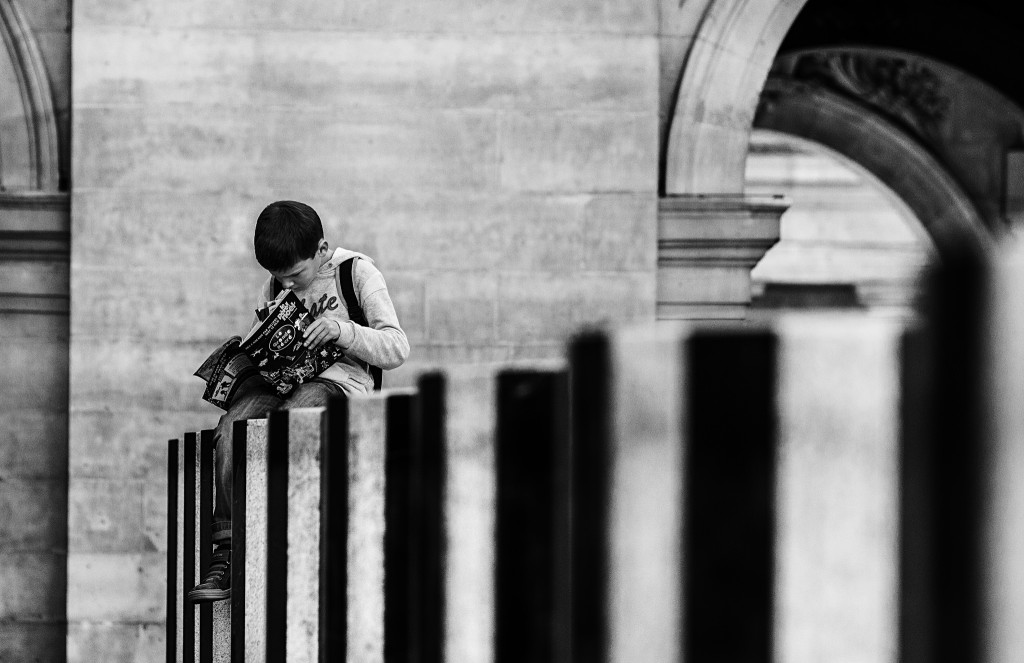
We publish 5–10% of the submissions we receive here at Structo. This means for each five-week submission window we are reading hundreds and hundreds of stories and poems. Happily, this quantity is tied to an ever-increasing quality of work sent in, but it does mean that we sometimes have a hell of a job to get back to everyone by two weeks after submissions close, especially as we try to give personal feedback where we can.
Here’s where you come in.
We are looking for two people to join the team, initially as fiction readers. I say initially as, if you’re interested, you would be more than welcome to pitch in with other aspects of the magazine, from design work to publicity to editing. Interest and enthusiasm will be repaid in kind, especially as these are voluntary positions. If you’re a writer yourself, you will find your time spent reading submissions especially invaluable.
Anyone is welcome to apply, regardless of location, background, or whatever else. We’re a motley crew. The only thing we care about is that you genuinely care about finding great writing and putting it in front of readers.
To apply, please choose a couple of stories from our back issues—one you like, and one you’re not so fond of. Write just a couple of sentences for each story, one a recommendation for publication, one a negative review. Then drop us an email with these mini-reviews and a hello.
We will be accepting applications until August the 15th. Be sure to get in touch if you have any questions.
— Euan
Photo (CC BY): Vincent Anderlucci
Issue 14
Issue 14 is now available! In a happy coincidence of symmetry, this latest issue features 14 short stories, 14 poems, and two interviews—with authors David Gaffney and Ursula K. Le Guin. All of this means that our 14th issue is our longest issue yet, by quite a way, sitting as it does at a chunky 138 pages.
 Two of the short stories featured in its page are the joint winners of the University of Leeds’ Chinese translation competition we helped out with a few months ago. It’s absolutely fascinating to see the differences between these two translations of Dorothy Tse’s vivid writing as they sit side-by-side.
The other short stories in this issue are a varied bunch, and come care of Giles Anderson, Mike Bonnet, Victoria Briggs, Thomas Chadwick, Annie Dawid, Ken Elkes, Pia Ghosh Roy, Richard Lakin, Catherine McNamara, Jonathan Pinnock, Naomi Richards, Anton Rose, David Shieh and Murzban Shroff.
On the poetry side, this issue features the talents of Kim Addonizio, Cristina Baptista, Anna Crowe (four translations from the Catalan of Manuel Forcano), Pablo Otavalo, David Russomano, Stewart Sanderson, Adie Smith and Sarah Stickney (two translations from the Italian of Gëzim Hajdari).
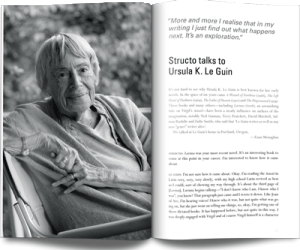 The issue is rounded out with two in-depth interviews. The first is with David Gaffney, the Manchester-based novelist and master of the (very) short story form, and the second is with the remarkable Ursula K. Le Guin. Both of our interviewees were incredibly generous with their time, and the final, fascinating conversations is a testament to this.
Issue 14 is currently winging its way to subscribers and those who pre-ordered. If you’d like to get your copy as soon as it’s available, you can buy a copy straight from us, or drop by one of our stockists.
Posts pre-April 2014 are here.